


Hardware components | ||||||
 |
| × | 1 | |||
 |
| × | 1 | |||
| × | 1 | ||||
| × | 1 | ||||
 |
| × | 1 | |||
| × | 1 | ||||
 |
| × | 1 | |||
Software apps and online services | ||||||
| ||||||
| ||||||
| ||||||
| ||||||
Video on youtube - https://youtu.be/VITeuc9cguY?si=RGAZnvSFIzWK6A2n
What is the project about?My Eye is an AI-powered wearable assistive system designed to help visually impaired people better understand and navigate their surroundings. The idea came from a simple question: “What if technology could help someone experience the world through audio?”
The current prototype is built on a helmet-mounted setup using the Arduino UNO Q. It combines computer vision, voice feedback, and an independent ultrasonic obstacle-detection system into one wearable device.
The goal is not simply to make another object-detection system, but to explore how Physical AI can interact with the real world and provide useful information to a person through sound.
I was interested in building something where AI could have a real-world human impact, rather than being limited to a screen.
Visually impaired people may need to understand what is around them without being able to see it directly. This inspired me to build a system that can detect objects, describe the surroundings through voice, and provide immediate obstacle alerts.
I wanted to combine the things I enjoy—AI, robotics, electronics, and embedded systems—into one practical assistive-technology project.
My Eye has two independent systems, designed so that basic safety does not depend entirely on AI.
1. AI Vision System 👁️
A USB camera captures the surroundings. The images are processed locally on the Linux side of the Arduino UNO Q, where YOLOv8n performs real-time object detection.
The detected information is converted into a spoken response using an offline speech pipeline, allowing the user to hear what the system detects.
Camera → YOLOv8n → Object Detection → Description → Text-to-Speech → Audio
2. Independent Obstacle Alert System 🚨
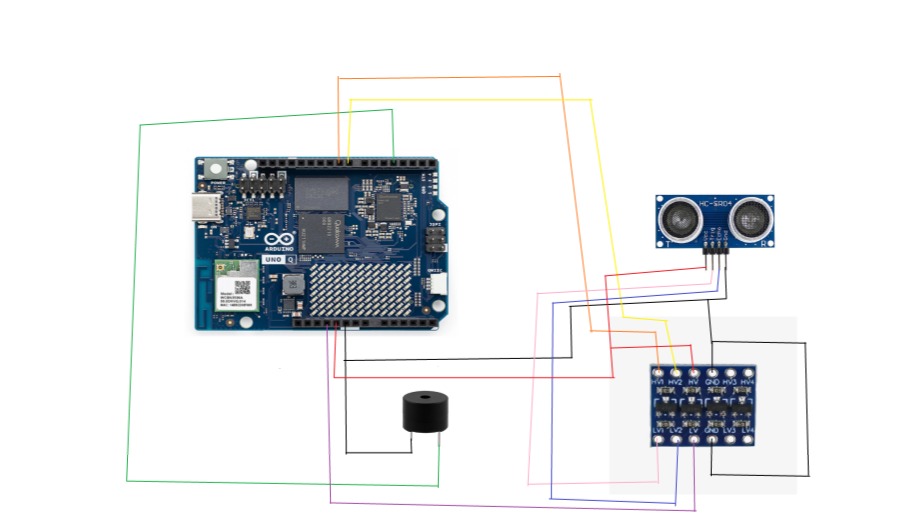
An HC-SR04 ultrasonic sensor continuously measures nearby obstacles. The measurement is handled independently by the microcontroller and triggers a buzzer when an obstacle comes within the configured safety range.
This means the basic obstacle warning can continue to work independently of the AI vision system.
The current version is a working helmet-mounted prototype created to demonstrate the complete concept physically.
The long-term vision is to make the system much smaller and more comfortable by integrating the same core technology into smart glasses, allowing the camera, processing system, and audio feedback to become part of a more practical wearable device.
The Video Link -


Comments