



Hardware components | ||||||
 |
| × | 1 | |||
 |
| × | 1 | |||
Software apps and online services | ||||||
| ||||||
Hello, my name is Carlo, and I'd like to show you the work done by two students at my school using a Unihiker K10 board.
They asked me if it was possible to create a security door control project for the secure management of a school laboratory or a bank. This project could obviously be implemented using multiple solutions, but we decided to use the Unihiker K10 because it allows us to perform almost all of the project's tasks using only a few external components.
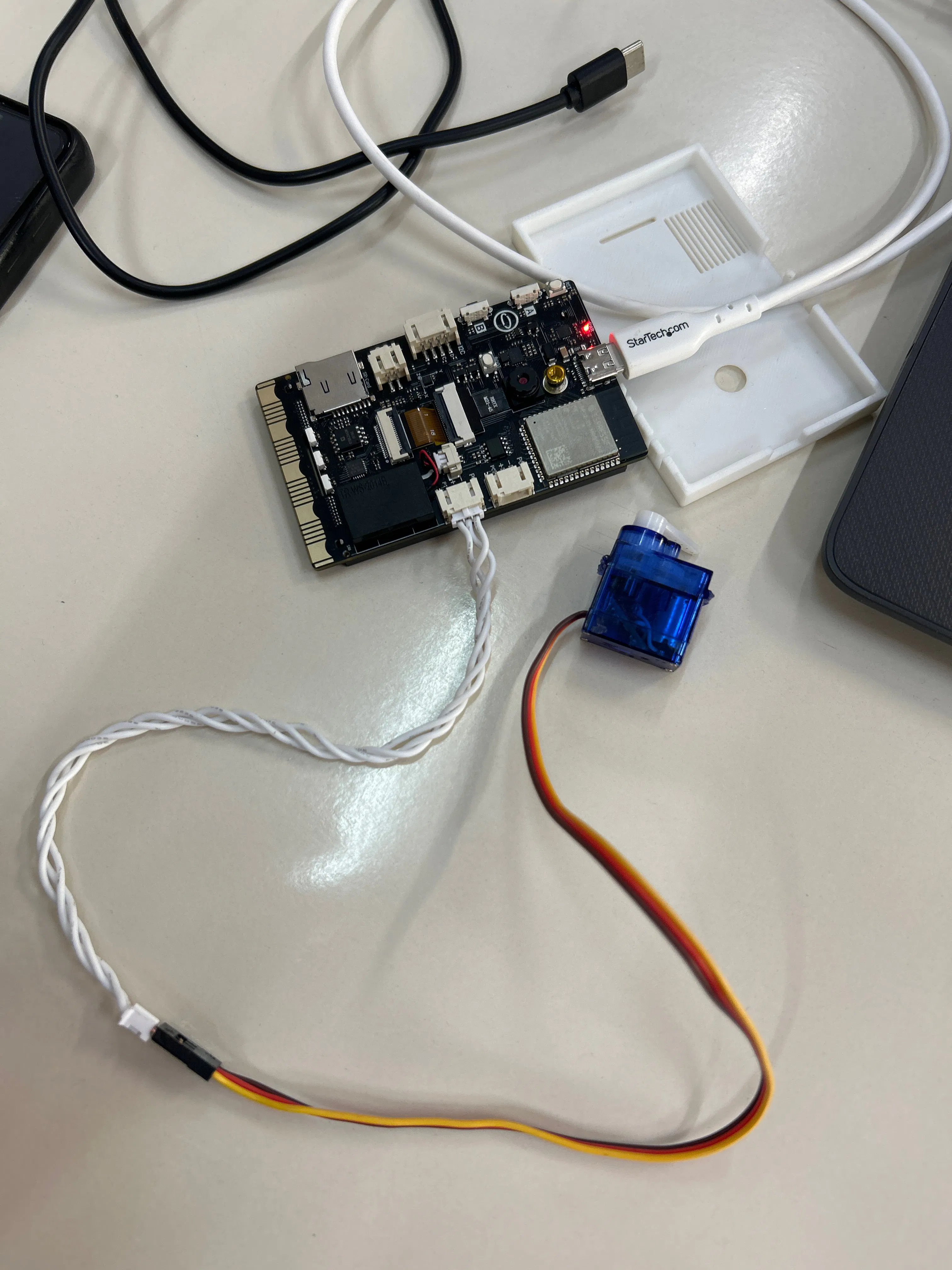
The two students are Andrea and Gabriele, and I simply gave them the board and some references for the datasheet and examples. The students worked very hard on the project to complete it in a very short time. They also created a small 3D model of the lab with a small door controlled by a servomotor to simulate the opening and closing of the security door when the user is recognized.
We will use the Unihiker K10 to monitor access to the lab. When a user approaches the board, they will be captured by the K10's integrated camera, and facial recognition will be performed. If the face belongs to a registered user with authorized access, the board will display a welcome message containing the recognized user's name and will open the door for 5 seconds, then close it again. If the face is not recognized, meaning it does not belong to an authorized person, the system will trigger an audible and visual alarm to signal the attempted intrusion.
The Face Recognition process
Face recognition is a very complex operation, and the K10 board performs the operations described below.
- Image Acquisition: the system captures an image of the face using the board's digital camera.
- Face Detection: once the image is obtained, the system identifies the presence and position of the face within it. This is done using algorithms that analyze typical human facial patterns: eyes, nose, mouth, and facial contours.
- Alignment and Normalization: the detected face is "aligned": the system rotates, resizes, and centers the image to make it comparable with others. This serves to neutralize variations due to perspective, tilt, expression, or lighting.
- Feature Extraction: this is the crucial phase: the face is transformed into a mathematical representation, called an embedding or template, which captures the distinctive features of the face and generates a numerical vector representing each individual face acquired.
- Comparison and Decision: finally, the vector associated with the face is compared with those in a database. The distance between the new vector and the stored ones is measured. If the distance is below a certain threshold, the two faces are considered to belong to the same person.
The recognition system will be based on a preliminary registration phase for authorized users. Each authorized user will be "registered" by the K10's camera, and each face will be transformed into a numerical vector representing its physical and geometric characteristics. These numerical vectors will be stored in the K10's non-volatile memory and used during the recognition phase.
Every time a person tries to access the system, their face will be scanned by the cam and a numerical vector with the facial characteristics will be generated. This vector will then be compared with those stored in the K10 and, if the "distance" between the obtained vector and one of the stored ones is less than a certain threshold, there will be positive recognition.
Each stored vector is associated with an id, by associating the name of the user authorized to access this id, we will be able to personalize the K10 welcome message by adding the user's name.
The project developed by the two students was implemented on a 3D model created by the students themselves, representing a bank. The model was trained with the students' faces and tested during an exam using the authors' faces (perfectly recognized) and those of some teachers (unrecognized). The system thus guarantees secure access to the bank only to authorized users who have "registered" their faces on the K10.
I was very satisfied with the result achieved and with the way the two students were able to use a technology they were unfamiliar with until a few weeks earlier.
I also think it's important to include the students' impressions of this project. So I asked Andrea and Gabriele some questions, and here they are, along with the answers I received.
1. What was your impression of using this board?
It was very simple to use, especially thanks to the presence of several integrated sensors, which allowed us to avoid installing external sensors and limit the number of electrical connections. Furthermore, the block-based programming software has made programming significantly simpler and more intuitive than traditional coding.
2. What problems and difficulties did you encounter?
The main issues we encountered were related to the synchronization of the components, particularly the servo motor and the camera. This forced us to modify the code several times, trying to make it more efficient and improve coordination between the different components.
3. What are the board's strengths?
In our opinion, the board's main strength is the presence of numerous sensors and components already integrated. These include temperature, humidity, and brightness sensors, the 240x320 LED display, the speaker, and the microphone. The presence of all these elements makes the board very versatile and suitable for numerous applications. Another strength is the availability of pre-compiled software and features, such as AI facial recognition, which allow you to more easily exploit the board's potential.
4. Possible future applications
As we better understand the board's potential, we believe the recognition system could be further developed and integrated, for example, into schools or offices to verify and record entry and exit. Using a WiFi connection and a server, it would be possible to track the status of school laboratories in real time and determine whether they are occupied and by whom. It would also be possible to trace who used a certain laboratory on a certain day, for example, in the event of system damage or tampering.
Among Andrea and Gabriele's future projects is the development of a real-time lip-reading system to help the hearing impaired.
Thanks to Andrea and Gabriele for their great work.


Comments