




Hardware components | ||||||
| × | 1 | ||||
| × | 1 | ||||
 |
| × | 1 | |||
Software apps and online services | ||||||
 |
| |||||
ESP8266 Buzzer Piano – Playing Melodies Using Code
This project demonstrates how to create a simple piano-style melody player using an ESP8266 development board and a buzzer. By precisely controlling timing and frequency through code, the ESP8266 generates musical notes that can be used to play familiar tunes like Jingle Bells.
The project is beginner-friendly and focuses on understanding how sound can be generated using GPIO pins and timing control, without requiring any external sound modules.
Why This Project?
Many beginners struggle to understand how microcontrollers generate sound beyond basic ON/OFF beeps. This project was created to clearly demonstrate:
- How a microcontroller can generate musical notes
- How timing and delays affect melody playback
- How different frequencies correspond to different notes
It also serves as a fun introduction to embedded programming using sound as immediate feedback.
How It Works
The ESP8266 outputs a square wave signal through one of its GPIO pins connected to a buzzer. Each musical note is represented by a specific frequency and duration.
The working principle is simple:
1. A GPIO pin is toggled at a specific rate to generate a tone
2. Each tone corresponds to a musical note
3. Delays are used to control note length and pauses
4. A sequence of notes creates a recognizable melody
All timing and note control is handled entirely through software.
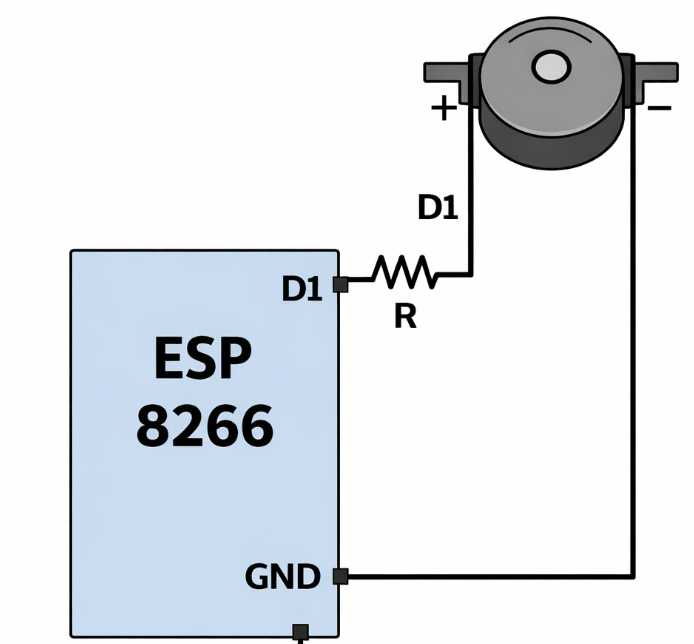
Hardware Setup
The hardware setup is minimal:
- ESP8266 development board
- Buzzer connected to a GPIO pin
- Common ground connection
This simple setup makes the project easy to replicate using basic components and breadboard wiring.
Software Implementation
The project is programmed using the Arduino IDE. Musical notes are defined as frequencies, and functions are used to generate tones with precise delays.
Key software concepts used:
- GPIO control
- Delay-based timing
- Frequency-to-note mapping
- Sequential playback logic
The code is structured so that melodies can be easily modified or extended.
Result and Demo
Once uploaded, the ESP8266 successfully plays musical tunes through the buzzer. The melody timing is smooth, and the notes are clearly distinguishable.
Possible Improvements
This project can be extended in many ways:
- Adding push buttons to play different notes
- Creating a keypad-based piano
- Playing multiple melodies
- Using Wi-Fi features of ESP8266 for remote control
Conclusion
This ESP8266 piano project is a great way to explore sound generation, timing control, and embedded programming concepts. It proves that even simple components can be used to create engaging and educational projects.
Note: The complete source code for this project is available in the Code section of this project.


Comments