




Hardware components | ||||||
| × | 1 | ||||
| × | 1 | ||||
| × | 2 | ||||
| × | 1 | ||||
Software apps and online services | ||||||
 |
| |||||
 |
| |||||
 |
| |||||
This article is my contribution for The Micron UV Robot Competition. The plan is to create a mobile UV sanitiser machine for use inside buildings. Rather than recite the rules and requirements, I will start with the challenges both in design and implementation, and later discuss the development process.
Design ChallengesMobility: The machine needs to be able to move around its environment. It must be large enough to carry the lamps, and batteries. It must be tall enough to get the lamps to a workable height. It must also be small enough to be able to navigate around obstacles and tight spaces.
Optical Power: Germicidal lamps work on the principle of sustained exposure. We want to be able cover the greatest area possible, so we need a lot of lamps to reduce the exposure time.
Intelligence: The UV light we are using is harmful to people, so the machine needs to be either remotely controlled or autonomous. A single machine can be remotely controlled, but for 24 hour operation or with a fleet of these machines, it is not practical. The machine needs to be able to detect and recognise obstacles and act accordingly.
Construction: This machine constitutes a hostile environment. There are high voltages for the lamps, which need to be managed and kept away from prying fingers. Secondly, the continual exposure to intense UV light will be detrimental to most plastics, rubber, some adhesives, etc. The superstructure therefore needs to be metal. This in turn adds weight, which means bigger motors and batteries.
Secondary Agents: Why limit ourselves to UV light? Could we also disperse an aerosol agent at the same time?
DesignI have used an inverted logic to design this particular robot. That is to say, I started from the finished product and work backwards from there.
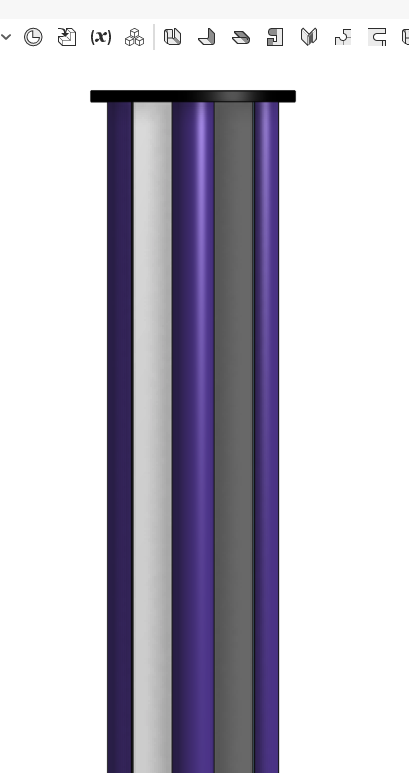
UV Wand Assembly: In order to boost the UV output, I am placing for Philips TUV36T5 tubes vertically in the "Wand" assembly. These tubes are backed by a polished alloy reflector, which directs the light outwards. A rendering of the lamp assembly is shown below:
The lamp tubes are 854mm long, making the entire assembly 864mm long and 90mm in diameter. The tubes are set back within the assembly to protect them from damage.
The specified tubes are a single-ended design. All electrical wiring is contained within the lower assembly. The top end cap is secured with 4 recessed M3 fixings.

Comments