


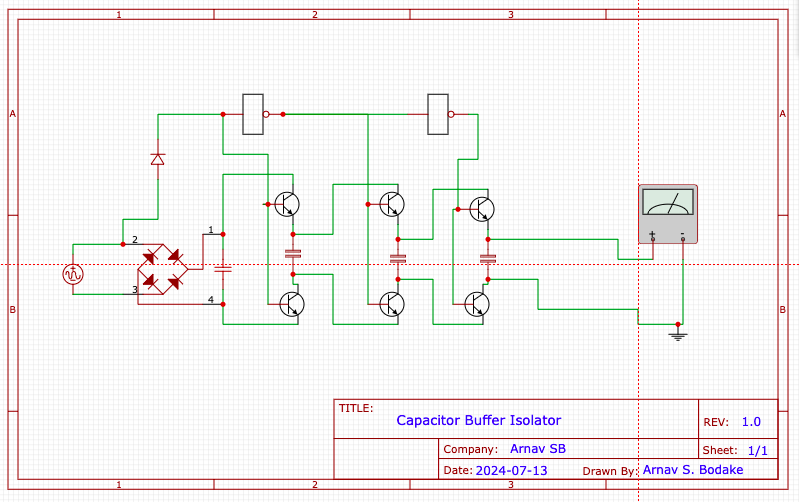
The circuit is designed to function similarly to a transformer with a 1:1 ratio combined with rectification and capacitive smoothing, providing isolation through its configuration. Here’s how the circuit can achieve this:
- AC to DC Conversion:The AC signal is first converted to DC using the bridge rectifier (D1). This rectifier ensures that the AC input is transformed into a DC output.
Charge Transfer and Isolation:
- The charge is then transferred through a sequence of capacitors and transistor pairs, effectively isolating the input from the output at each stage. Each transistor pair acts as a controlled switch, ensuring that the charge is transferred in a step-by-step manner, maintaining isolation.
- The capacitors store charge and smooth the DC signal, while the transistors control the transfer of charge from one stage to the next, providing isolation similar to what a transformer would achieve in a power transfer context.
Galvanic Isolation:
- In a traditional transformer, galvanic isolation is achieved by inductively coupling the primary and secondary windings without a direct electrical connection. In this circuit, the isolation is achieved through the controlled switching provided by the transistors.
- Each stage (capacitance and switching) isolates the previous stage from the next, effectively breaking any direct electrical path and providing a form of galvanic isolation.
Initial Rectification and Smoothing:
- The AC input is rectified and initially smoothed by the first capacitor.
- Initial Rectification and Smoothing:The AC input is rectified and initially smoothed by the first capacitor.
Charge Transfer Through Transistor Pairs:
- Transistor Pair 1: Transfers charge from the initial smoothing capacitor (capacitor1) to capacitor 2, isolating the input from the first stage( isolation ).
- Transistor Pair 2: Transfers charge from capacitor 2 to capacitor 3, further isolating the previous stage.
- Transistor Pair 3: Transfers charge from capacitor 3 to capacitor 4, providing the final stage of isolation.
- Charge Transfer Through Transistor Pairs:Transistor Pair 1: Transfers charge from the initial smoothing capacitor to capacitor 2, isolating the input from the next stage and then turns off.Transistor Pair 2: Transfers charge from capacitor 2 to capacitor 3, further isolating the previous stage and then turns off.Transistor Pair 3: Transfers charge from capacitor 3 to capacitor 4, providing the final stage of isolation and then turns off.
Output:
- The final smoothed and isolated DC output is available across the last capacitor (capacitor 4), and its voltage can be monitored using the connected meter.
- Conclusion:
While the circuit does not use traditional transformers or optocouplers, it achieves galvanic isolation through its sequential capacitive charging and controlled transistor switching. This method can be effectively modeld as a transformer with a 1:1 ratio combined with a rectifier and smoothing capacitors, providing both voltage conversion and isolation.
Circuit Representation:To better understand this, here’s a conceptual representation:
AC Input:
- Input AC signal.
Rectification:
- Bridge rectifier converts AC to DC.
Initial Smoothing:
- Capacitor smooths the pulsating DC.
Sequential Charge Transfer:
- Transistor pairs and capacitors transfer and each provide isolation.
Final Output:
- Smoothed and isolated DC output.
This method ensures that the input and output are isolated, simulating the behavior of a galvanically isolated transformer circuit.
This is an idea of Arnav Sudhir Bodake. Mail- arnavbodake11@gmail.com


Comments