



Hardware components | ||||||
 |
| × | 1 | |||
 |
| × | 1 | |||
Software apps and online services | ||||||
 |
| |||||
 |
| |||||
Edge AI is becoming increasingly important in robotics, automation, smart sensors, and embedded systems.
Two boards currently attracting attention are the Arduino VENTUNO Q and the Raspberry Pi 5.
Although both platforms can be used for AI-related projects, they are designed with very different goals in mind.
The Raspberry Pi 5 focuses on affordability, flexibility, and the huge Linux maker ecosystem.
The Arduino VENTUNO Q, on the other hand, is designed as a dedicated edge AI and robotics platform with hardware acceleration for AI workloads.
In this article, we’ll compare:
- AI performance
- Hardware architecture
- Robotics potential
- Beginner friendliness
- Expandability
- Real-world project use cases
By the end, you should have a clearer idea of which board makes more sense for your own AI projects.
Disclosure: As an Amazon Associate, I earn from qualifying purchases.Hardware Overview
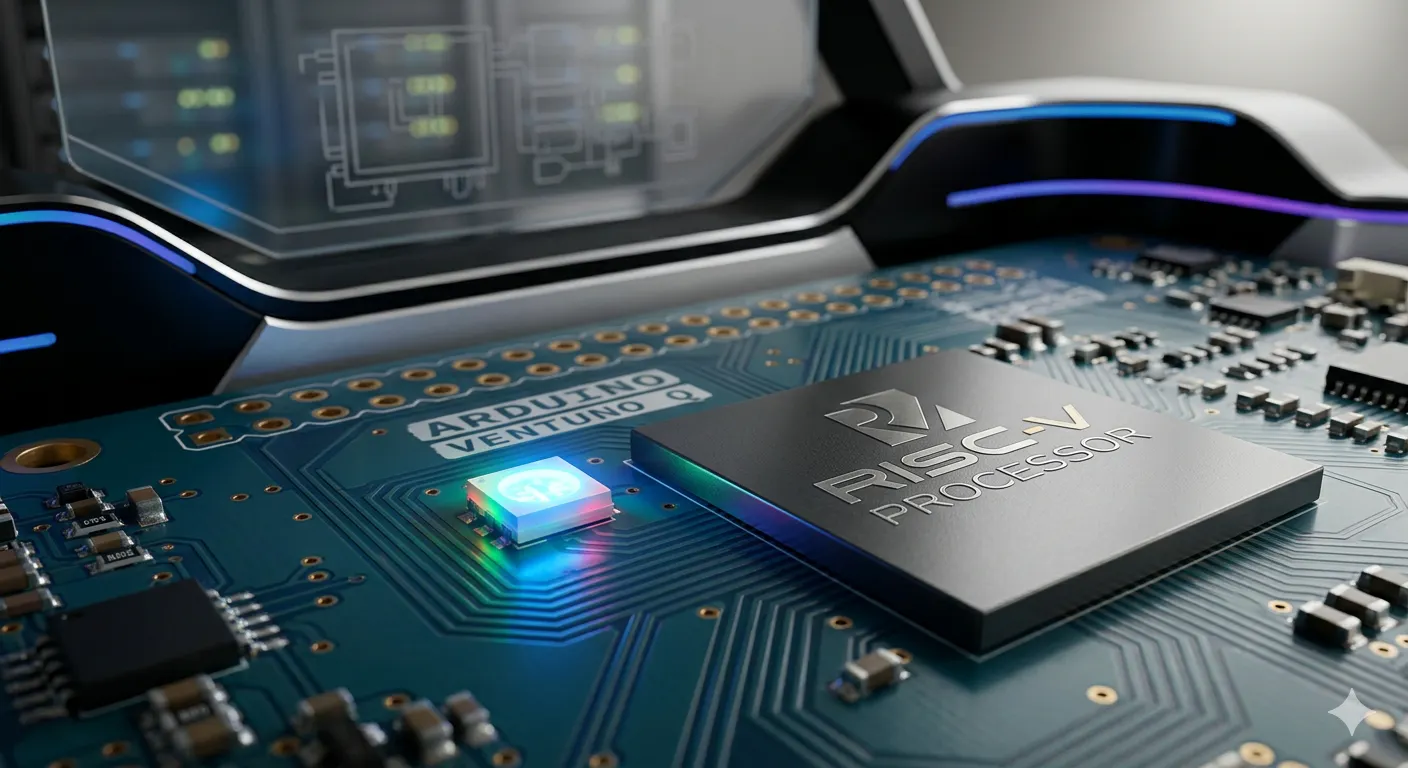
The Arduino VENTUNO Q is a next-generation edge AI platform built around Qualcomm AI hardware and a dedicated STM32 real-time microcontroller.
Main features include:
- Qualcomm Dragonwing IQ8 processor
- Dedicated AI acceleration
- Up to 40 TOPS AI performance
- STM32H5 real-time MCU
- LPDDR5 memory
- NVMe SSD support
- Wi-Fi 6 and Bluetooth 5.3
- ROS2 and robotics support
Unlike traditional maker boards, the VENTUNO Q is heavily focused on:
- Computer vision
- Robotics
- AI inference
- Edge computing
- Industrial automation
The Raspberry Pi 5 remains one of the most popular single-board computers for makers and embedded Linux projects.
Main features include:
- Quad-core ARM processor
- PCIe support
- Dual 4K display output
- Strong Linux ecosystem
- Massive community support
- Extremely large accessory ecosystem
Although it is not an AI-focused platform, it can still run:
- TensorFlow Lite
- OpenCV
- Voice assistants
- Lightweight object detection
- Local AI models
Its biggest advantage is accessibility.
There are already thousands of tutorials, libraries, and accessories available for Raspberry Pi projects.
AI Architecture ComparisonArduino VENTUNO QThe VENTUNO Q was designed specifically for edge AI workloads.
Advantages include:
- Dedicated AI acceleration
- High inference throughput
- Real-time processing
- Lower AI latency
- Robotics-oriented architecture
- Industrial-grade capabilities
This makes it more suitable for:
- Smart cameras
- Autonomous robots
- AI vision systems
- Sensor fusion
- Real-time edge inference
The Raspberry Pi 5 is better described as a general-purpose Linux computer.
Advantages include:
- Easier Linux environment
- Huge software support
- Beginner-friendly setup
- Lower entry cost
- Large accessory ecosystem
It is ideal for:
- DIY automation
- Beginner AI projects
- Home servers
- Educational projects
- Rapid prototyping
One of the biggest differences between these platforms is real-time control.
The Arduino VENTUNO Q combines AI processing with an STM32 real-time microcontroller.
This is especially useful for robotics applications where timing and deterministic behavior are important.
Examples include:
- Autonomous navigation
- Robot arms
- Industrial control systems
- AI-assisted robotics
- Real-time sensor processing
The Raspberry Pi 5 can still be used for robotics, but Linux is not naturally optimized for hard real-time tasks without additional hardware or software layers.
Maker Ecosystem ComparisonRaspberry Pi 5 AdvantagesThe Raspberry Pi ecosystem is currently much larger.
Advantages include:
- Easier tutorials
- Better beginner support
- Huge community
- Lower learning curve
- More beginner accessories
- Faster project setup
For many makers, this translates into faster results and easier troubleshooting.
Arduino VENTUNO Q AdvantagesThe VENTUNO Q is more specialized.
Advantages include:
- Better edge AI acceleration
- More advanced robotics potential
- Industrial-oriented architecture
- Stronger AI hardware
- Better future scalability for AI workloads
This board is likely more attractive to advanced users experimenting with next-generation AI systems.
Which One Should You Choose?Choose Arduino VENTUNO Q if:- You want serious edge AI capabilities
- You are interested in robotics
- You need real-time processing
- You want advanced AI acceleration
- You are experimenting with computer vision systems
- You are a beginner
- You want lower cost
- You prefer easier tutorials
- You want faster project development
- You need a flexible Linux platform
For most hobbyist and beginner projects, Raspberry Pi 5 is still the easiest recommendation.
For advanced robotics and edge AI systems, the Arduino VENTUNO Q is a very interesting platform to watch.
Final ThoughtsThe Arduino VENTUNO Q represents a new generation of maker-oriented edge AI hardware.
It combines AI acceleration, robotics support, and real-time processing into a platform designed for advanced embedded systems.
At the same time, Raspberry Pi 5 continues to dominate the DIY ecosystem because of its accessibility, community support, and flexibility.
Both boards are exciting, but they target different audiences.
For practical maker projects and learning, Raspberry Pi 5 remains one of the strongest platforms available.
For future-facing AI and robotics experimentation, the VENTUNO Q could become an important new option for advanced makers and developers.
Recommended Hardware- Raspberry Pi 5
- Raspberry Pi Active Cooler
- NVMe SSD HAT
- OLED Display Module
- USB-C Power Supply
- Breadboard and Jumper Wire Kit


Comments