OverviewThis project stems from an idea I had early on in my embedded design course. I was trying to think of interesting potential systems that could be created from reasonably simple base components, and came up with the concept of what is essentially 'budget VR' - a single screen connected to a single frame of a virtual world, using an IMU to dynamically slice it into an image that fits within our simulated viewport.
It's a fun mixture of art and engineering and I am reasonably happy with the design!
Hardware1 / 5 • Front View of the LED Matrix.
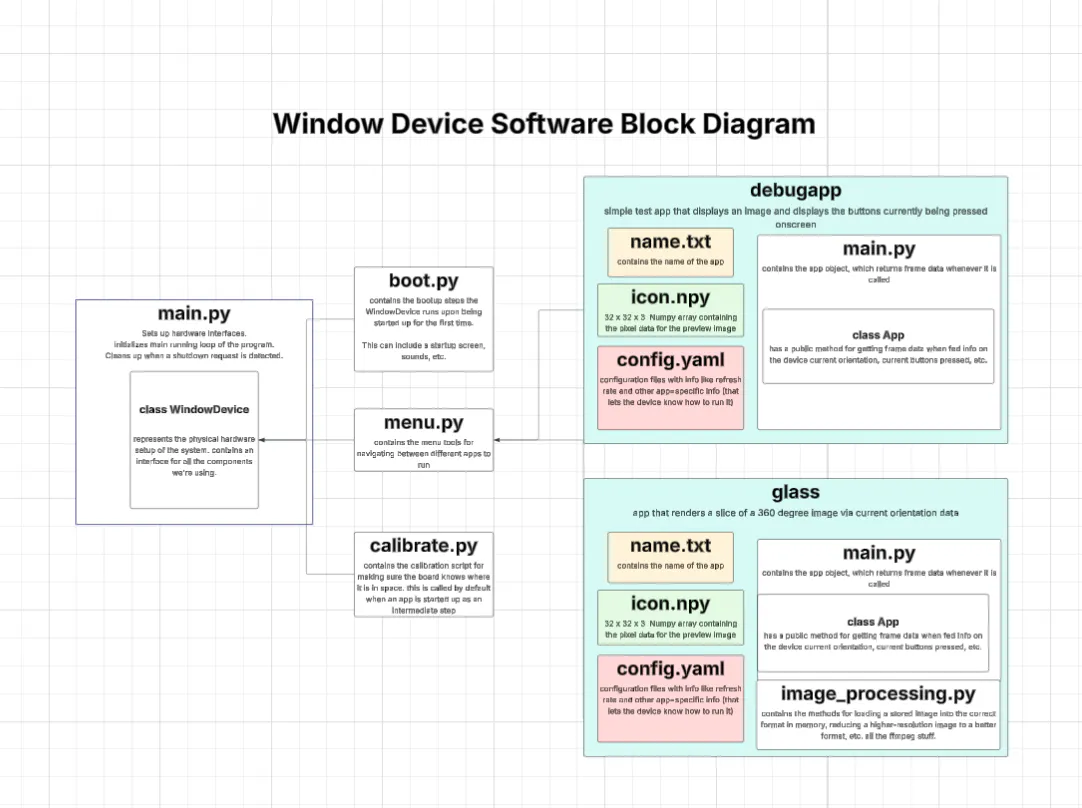
SoftwareThe software system itself is designed around a state machine that dynamically tracks which system the Window is running and hands off control & the abstract device interfaces between different applications without allowing any of them to control it at the same time. This lets us cleanly separate our applications into a neat filesystem, along with abstracting all of the hardware away at an application level.
This layer of abstraction is particularly useful for local development... I have a whole parallel pygame-driven simulator for the device that I can use to run and test my apps and see them behave identically to how they would run on the real machine.
Challenges with the DesignInterfacing with the monitor took quite a bit of time, and required altering the device tree of the Pocketbeagle to use prussdrv instead of the PocketBeagle's default remoteproc (which was an issue that took QUITE a while to diagnose and involved a solution I still don't fully understand).
The compiled installation of the pyledscape library we're using for this is also a bit of a black-box when it comes to source code and thus I have no way of figuring out how to allow it to run without sudo invocation (but it does need that!).
Another issue I ran into was that I initially modeled an entire 3D printed frame for a much smaller screen, and when I went to modify my design I ran into the issue of the printbeds being far too small to fit my new frame. Currently that issue has been solved by crudely subdividing the two parts into eight parts, which can be glued together and assembled after printing. In the future I will likely turn to more intentionally designed small parts or laser cutting to finalize a real frame design.
Future PlansI did my best to design the software for this tool such that the actual applications that run on it are fairly abstracted from the hardware and easy to add onto... in that regard, I have a programming project coming up involving a Conway's Game of Life style simulation of stellar life cycles in a gas cloud and I plan to port that over onto the Window! It should be fairly simple.






_3u05Tpwasz.png?auto=compress%2Cformat&w=40&h=40&fit=fillmax&bg=fff&dpr=2)

Comments