



Hardware components | ||||||
| × | 1 | ||||
| × | 1 | ||||
| × | 1 | ||||
 |
| × | 1 | |||
Modern environmental challenges such as climate change, deforestation, water pollution, and biodiversity loss require continuous, large-scale monitoring systems capable of operating in remote and harsh environments. Traditional monitoring methods are often limited by high infrastructure costs, lack of connectivity, and the need for frequent human intervention
This project aims to build a low-power, scalable environmental monitoring system for protecting natural ecosystems such as forests, rivers, and protected green areas. The system uses the SenseCAP S2100 LoRaWAN Data Logger/DTU as the central communication gateway between environmental sensors and a cloud-based monitoring platform.
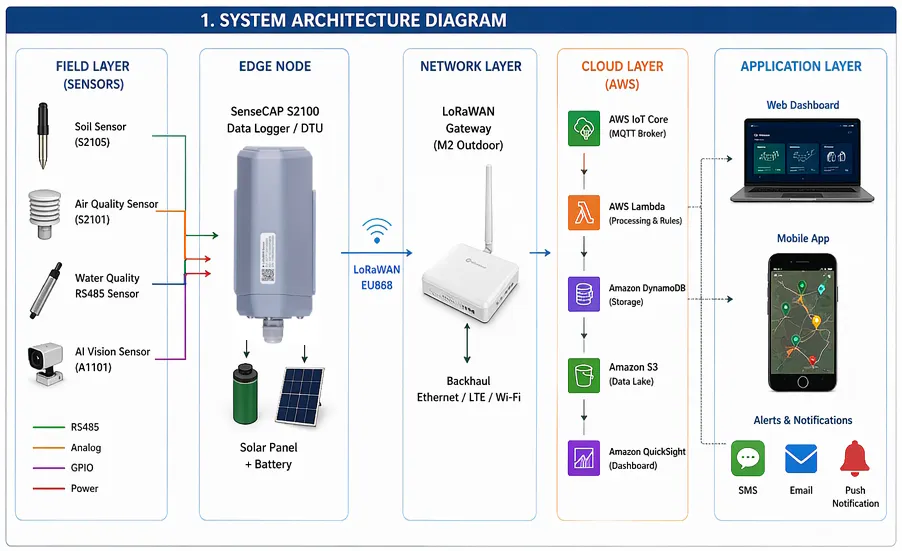
The system is built around a layered IoT architecture:
- Sensing Layer (Field Nodes)Environmental sensors measure soil, air, and water conditions.
- Edge Communication Layer (SenseCAP S2100)Collects sensor data via RS485 / analog / GPIO and transmits it via LoRaWAN.
- Network Layer (LoRaWAN Gateway)Transfers data from field devices to the cloud.
- Cloud & Analytics LayerProcesses data for visualization, alerts, and AI-based anomaly detection.
The solution is designed for remote, hard-to-access areas where traditional wired infrastructure is impossible, enabling real-time environmental data collection and early detection of ecological threats such as pollution, drought stress, illegal logging, or wildfire risks.
The system demonstrates how low-power wide-area networking (LPWAN) can transform ecological monitoring and conservation practices.
At the core of the proposed system is the SenseCAP S2100, a versatile LoRaWAN data logger designed to interface with RS485, analog, and GPIO-based sensors. Its role is to act as an intelligent edge device that collects raw environmental data from multiple sensors deployed in forests, rivers, wetlands, and agricultural zones. By supporting multiple industrial communication standards, the S2100 enables integration with a wide range of environmental probes, including soil moisture sensors, water quality meters, and air pollution detectors. This flexibility makes it particularly suitable for heterogeneous ecosystems where different environmental parameters must be monitored simultaneously.
The system is designed as a multi-layer architecture. At the field level, sensors continuously measure key environmental indicators such as soil temperature, humidity, electrical conductivity, air quality, and water contamination levels. In addition, AI-enabled vision sensors can be used to detect human intrusion, illegal logging, or wildlife activity. These sensors are connected to the S2100, which aggregates and preprocesses the data. This edge processing reduces noise, formats sensor readings, and prepares data packets for transmission.
The second layer consists of the LoRaWAN communication network. Unlike traditional Wi-Fi or cellular networks, LoRaWAN provides long-range, low-power wireless communication that can cover several kilometers in rural or forested environments. This makes it ideal for environmental monitoring systems deployed in areas without reliable infrastructure. The S2100 transmits data to a nearby LoRaWAN gateway, which acts as a bridge between field devices and the internet.
The third layer is the cloud infrastructure, where data is stored, analyzed, and visualized. Once sensor data reaches the cloud, it can be processed using rule-based systems or artificial intelligence models. For example, if soil moisture drops below a critical threshold while temperature rises significantly, the system may generate a wildfire risk alert. Similarly, abnormal changes in water pH or turbidity can indicate potential pollution events. These insights are then displayed through dashboards accessible to environmental agencies, researchers, and conservation organizations.
One of the most important advantages of this system is its scalability. A single LoRaWAN gateway can support hundreds of S2100-connected sensor nodes, allowing entire forests or river basins to be monitored in real time. Furthermore, the low power consumption of LoRaWAN devices enables long-term deployment using battery or solar power, reducing maintenance costs and environmental impact.
Another key benefit is early warning capability. Environmental disasters such as wildfires, floods, or chemical leaks often develop gradually before becoming critical. By continuously monitoring multiple environmental parameters, the system can detect early signs of these events and trigger alerts. This allows authorities to respond faster, potentially minimizing ecological and economic damage.
From a technological perspective, the integration of Seeed Studio devices such as soil sensors, air quality modules, and AI vision systems enhances the system’s accuracy and functionality. The combination of physical sensing, edge computing at the S2100 level, and cloud-based analytics creates a complete IoT ecosystem tailored for environmental protection.
The core device of the system:
- Connects to RS485 environmental sensors, analog probes, and GPIO-based devices
- Converts sensor signals into LoRaWAN transmissions
- IP66-rated for outdoor deployment
- Supports long-range communication (up to 10 km line-of-sight)
- Battery-powered with optional solar or external 12V supply
Used for forest and soil health analysis:
- Measures soil moisture, temperature, and electrical conductivity (EC)
- Helps detect drought stress and vegetation degradation
- Works seamlessly with S2100 via LoRaWAN network integration
Monitors atmospheric conditions:
- Temperature and humidity tracking
- Supports microclimate analysis in forest ecosystems
- Useful for wildfire risk prediction and climate trend monitoring
- Aggregates data from multiple S2100 nodes
- Forwards data to cloud platforms via Wi-Fi/Ethernet/LTE
- Enables wide-area environmental monitoring networks
- Build a scalable environmental monitoring system
- Enable real-time remote sensing of ecosystems
- Detect environmental risks early (fire, pollution, drought)
- Reduce manual inspection requirements
- Use low-power long-range communication (LoRaWAN)
Sensor data is collected at field nodes, processed by the S2100, and transmitted via LoRaWAN to a gateway. The gateway forwards data to the cloud where analytics and visualization are performed.
The proposed LoRaWAN-based environmental monitoring system demonstrates a practical and scalable approach to addressing modern ecological challenges. By leveraging the SenseCAP S2100 as a central data logger and integrating it with a network of environmental sensors and cloud analytics, it becomes possible to achieve continuous, real-time monitoring of natural ecosystems. This approach not only improves data collection efficiency but also supports proactive environmental protection strategies. As climate and ecological pressures continue to grow, such IoT-based systems will play an increasingly important role in safeguarding the planet’s natural resources.
System Components- SenseCAP S2100 LoRaWAN Data Logger/DTU
- SenseCAP S2105 Soil Sensor
- SenseCAP S2101 Air Quality Sensor
- SenseCAP A1101 AI Vision Sensor
- SenseCAP LoRaWAN Gateway
- Cloud IoT platform (SenseCAP Portal / Node-RED / AWS IoT)


Comments