



A dedicated spot welder strong enough to fuse nickel strips onto 18650 and 21700 lithium-ion cells typically costs around ₹7, 000 (~$74 USD) in the market. As someone who builds robots, drones, and custom battery packs at Humanix Tech Lab, I needed one — but not badly enough to spend that kind of money on a tool I'd only use occasionally.
So I built my own portable capacitor-discharge spot welder for about ₹1, 500 (~$16 USD) using a readymade spot welder module — and powered it with a 3S LiPo battery I already own and use for other projects (robot power, flight packs, day-to-day experiments). Instead of locking that battery into one single-purpose tool, I wired everything with XT60 connectors on both ends, so the same battery simply plugs into whichever project needs it — spot welder today, robot or drone tomorrow.
This build is really a reusable, multipurpose battery setup, not a single-purpose tool. The spot welder is just one of several plug-and-play loads a high-discharge LiPo can power. The wiring stays dead simple — battery in, probes out — making this an approachable DIY electronics project even if you're not deeply into circuit design.
Core components- Capacitor-discharge spot welder module (5x MOSFETs + capacitor bank)
- 3S 3300mAh 35C (70C burst) LiPo battery
- XT60 connectors (battery side + probe side)
- 12AWG wire and copper welding rods
- PVC enclosure
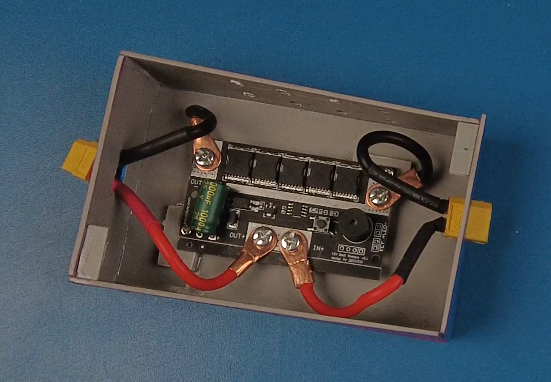
- Understand the module — IN+/IN− for battery input, OUT+/OUT− for welding probes, an onboard capacitor bank, and 5 MOSFETs delivering the high-current pulse.
- Bypass the onboard switch with an external pushbutton so mode-selection is accessible from outside a sealed enclosure.
- Prepare the welding probes using 12AWG wire and copper rods, insulated with heat shrink.
- Wire XT60 connectors on both the battery input and probe output — this is what makes the whole build plug-and-play.
- Mount everything inside a PVC enclosure with cutouts for the connector, probes, and trigger switch.
- Power up and test — plug in the LiPo, wait for the ready buzzer, touch probes to your nickel strip or cell tab, and trigger the weld.
I tested this budget spot welder across multiple materials as part of ongoing experiments at Humanix Tech Lab:
- 0.15mm nickel strip — strong, clean welds that passed a pull test easily.
- 0.2mm nickel strip — too thick for this setup at these settings; caused heavy sparking and melted through in spots instead of forming a clean weld.
- Thin ribbon wire — burned through almost instantly, a clear demonstration of how much current a high-C LiPo can deliver.
- Custom 3S 21700 battery pack — built using this welder, with noticeably cleaner joints than soldering.
- High-C LiPo batteries can deliver very large short-circuit currents — never let probe tips or battery terminals touch accidentally.
- Wear eye protection — there's real spark and spatter during welding.
- Work on a non-flammable surface.
- Unplug the battery when not actively welding.
- Follow standard LiPo safety practices (no punctures, no extreme heat, no shorts).
This project proves a single multipurpose LiPo battery, paired with the right plug-and-play connectors, can serve many roles instead of being dedicated to one tool. For about a fifth of the cost of a commercial spot welder, Humanix Tech Lab now has a reliable way to build 18650/21700 battery packs at home — while the battery itself stays free to power whatever's next on the bench.
Follow the Build JourneyI document projects like this regularly — robots, IOT, battery packs, and other DIY electronics builds:
- 🔴 YouTube: youtube.com/@HumanixTechLab
- 📸 Instagram: instagram.com/humanixtechlab


Comments