



Got a Raspberry Pi sitting in a drawer after its stint as a media center or retro gaming console? It's time for a promotion. This guide will walk you through a hardware upgrade that transforms your retired Pi into the brain of a professional-grade, open-source quadruped robot—the Hiwonder PuppyPi. This isn't just another project; it's about giving your idle compute core a new body and a new purpose.
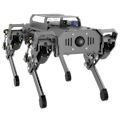
Part 1: Why PuppyPi? The Perfect Bridge from Board to RobotThe PuppyPi's design philosophy perfectly complements your old Raspberry Pi. Think of it as a complete, precision-engineered robot body—featuring a CNC aluminum frame, eight high-torque smart servos, an HD wide-angle camera, and abundant expansion ports—that's just waiting for a "brain." That's where your Pi comes in. This combination unlocks a unique value proposition: you don't need to buy an expensive, all-in-one robot. Instead, you leverage existing, fully open-source hardware to build a platform that's equally capable and infinitely more customizable. With PuppyPi's pre-configured system image (including ROS, servo drivers, and vision libraries), you skip the tedious setup and dive straight into creation.
Part 2: From Zero to Hero: Bringing Your Robot Dog to LifeThe journey begins with straightforward hardware integration. Securely mount your Raspberry Pi inside the PuppyPi chassis and connect all servo and camera cables. The first thrill comes on power-up. Once connected to Wi-Fi, you can access a full Linux terminal via SSH or a web interface—your robot is now under your command. The first major milestone is the stand-up sequence. Running a simple calibration script brings the robot to life, as all eight servos work in unison to lift the body steadily. Then, with your first walk command, you'll watch it take its inaugural steps. In that moment, your old Pi is officially reborn.
Check complete PuppyPi tutorials here or go PuppyPi GitHub for codes.Part 3: Core Project #1: Unlocking SLAM and Autonomous Navigation
Basic movement is just the start. True intelligence comes from perceiving and understanding the environment. Enter our first core project: Low-Cost LiDAR SLAM Navigation. By adding the optional Time-of-Flight (ToF) LiDAR module, your Raspberry Pi can run ROS-based SLAM algorithms like gmapping. Start the mapping process and pilot the PuppyPi around a room. In real-time, using the Rviz visualization tool, you'll see a precise 2D map being created. This map is a spatial model of the world. You can then set a goal point on it, and your robot will use navigation stacks to autonomously plan a path, avoid obstacles, and reach its destination. This project perfectly demonstrates how consumer-grade hardware can tackle core robotics challenges.
Beyond understanding space, a robot can understand you. The second project focuses on Multimodal AI Interaction. Leveraging your Pi's capable processor, you can run lightweight AI models locally. For instance, using OpenCV and pre-trained models, you can enable face recognition or gesture control through the PuppyPi's camera. Program simple behaviors: when it detects your "open palm" gesture, it walks over and sits; a "stop" gesture halts all movement. Taking it further, integrate an offline voice recognition module for basic voice commands. This transforms the PuppyPi from an automated machine into an intelligent companion capable of natural, intuitive interaction.
With navigation and interaction skills, your robot dog can graduate from lab prototype to practical home applications. Imagine it as a mobile sentry, performing scheduled patrols while you're out, using its camera for anomaly detection and sending alerts. Or, as a smart home assistant, it could learn your layout to execute simple fetch tasks like "go see who's in the living room." These scenarios require more complex integration, but PuppyPi's open and modular nature provides the perfect foundation for prototyping these ideas.
The true appeal of PuppyPi is its potential as a limitless platform. Your exploration shouldn't stop here. Consider experimenting with a multi-robot swarm—with two old Pis and two PuppyPi bodies, you can research simple cooperative behaviors over Wi-Fi. It also serves as an excellent platform for advanced ROS 2 & Micro-ROS development, allowing you to delve into everything from low-level servo control to high-level algorithm planning. The community is already exploring integrations like robotic arms for mobile manipulation, or more complex reinforcement learning for gait training. Your old hardware is a key that unlocks the door to cutting-edge robotics.
ConclusionThis project reboots more than just a dormant Raspberry Pi; it reboots a sense of possibility. PuppyPi turns abstract computing power into tangible, interactive physical intelligence, showcasing the formidable synergy of open-source hardware and software. We look forward to seeing your code forks on GitHub and, more importantly, the unique skills you teach your robot dog. After all, the best project is the one that inspires the next. Now, open that drawer and give your old Pi the brilliant future it deserves.


Comments