



Transform a quadruped robot into an interactive character using Scratch and LEGO-compatible hardware.
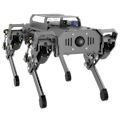
01 Overview: From Sensors to PersonalityThe "Angry Bull" mode is a perfect case study in the Sense-Think-Act robotic loop. By integrating an ultrasonic sensor with graphical programming, Hiwonder MechDog transitions from a simple walking robot to a reactive character that "defends" its space.
When an obstacle is detected, the robot doesn't just stop—it transforms. Using a LEGO-compatible horn attachment, it actively pushes the obstacle aside, demonstrating how simple logic can create complex, dramatic interactions.
The Logic Pipeline:
- Perception: The head-mounted ultrasonic sensor emits high-frequency sound waves. By calculating the Time-of-Flight (ToF) of the returning echo, the system determines the exact distance to an object.
- Decision: Using Scratch, we define a threshold. If the distance < 20 cm, the "Bull" state is triggered.
- Execution: The controller sends PWM signals to the neck servos to position the horns, while the gait engine drives the legs forward to "charge" and clear the path.
While the "Angry Bull" mode adds personality, adding a LEGO-compatible robotic arm grants the MechDog physical manipulation capabilities. This upgrades the platform from a mobile base to a multi-tasking utility robot.
Kinematics and Control:- Structural Versatility: Using the MechDog’s chassis expansion holes, users can mount a 2-DOF (Degrees of Freedom) arm powered by high-torque servos.
- Coordinate-Based Movement: Instead of manual servo degree mapping, the system utilizes Inverse Kinematics (IK). You program the end-effector to move to an $(X, Y, Z)$ coordinate, and the library automatically calculates the required joint angles.
- The "Smart Courier" Workflow: By combining the arm with a gripper, you can automate complex sequences: Detect object -> Close gripper -> Lift -> Navigate to target -> Release.
💡Explore your MechDog tutorials and get source code, video guides, etc.03 Programming with Scratch: The Master Key
The complexity of servo synchronization and sensor fusion is abstracted away through a Scratch-based graphical interface. This allows makers to focus on high-level logic rather than low-level C++ debugging.
Key Programming Concepts:- Event-Driven Architecture: Blocks like "When Distance < 20" act as interrupts, making the robot responsive to its environment in real-time.
- Parallel Processing: Scratch allows for concurrent scripts. You can run an ultrasonic obstacle avoidance script simultaneously with a camera-based line-following script without logic conflicts.
- Real-time Debugging: The visual nature of the blocks allows for instant feedback. You can monitor variable shifts (like distance values) live on the screen as the robot moves, significantly shortening the iteration cycle.
Once you master the sensor-arm synergy, the possibilities for customization are endless:
- The "Guardian Angel": Face the ultrasonic sensor upward. When a hand reaches over the robot, it can trigger the arm to raise a LEGO shield.
- Autonomous Sorting: Use the onboard camera to identify block colors. The MechDog can then navigate to the block, pick it up with the arm, and sort it into designated "delivery zones."
- Interactive Storytelling: Program the robot to change its gait or arm gestures based on how close a person is—creating a "shy" puppy that backs away or an "excited" dog that waves its arm when approached.
The "Angry Bull" project reveals the core philosophy of Hiwonder MechDog: bridging the gap between professional robotics (IK, sensor fusion, gait control) and the maker spirit (LEGO, Scratch, micro:bit).
By simplifying the "barrier to entry" through graphical blocks, we turn complex automation into a game of logic. You don't need to be a professional engineer to build a smart machine; you just need to be a thinker who knows how to snap "logic bricks" together.


Comments