



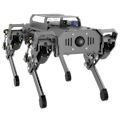
In the maker world, the true fun begins after unboxing—it lies in how we use a tool to bring those sky's-the-limit ideas to life. MechDog, an out-of-the-box, open-source AI vision robot dog, holds a charm that goes far beyond precise gaits and fluid programming. Today, we delve into its two core expansion genes: LEGO compatibility and micro:bit support, exploring how to transform this standard robot dog into a unique creative companion.
Part 1: When MechDog Meets micro:bit—Infusing a Soul for Perception and InteractionWhile the MechDog's built-in ESP32-S3 master controller expertly handles movement, the micro:bit becomes the perfect "brain expansion" for injecting simpler sensing and interactive logic. This division of labor (micro:bit for perception/decision, ESP32 for motion execution) opens up a playground for low-barrier, high-creativity projects.
- Emotional Interaction: With some programming, a simple touch on the micro:bit can make the MechDog wag, light up its LED array with a happy pattern, or even change its on-screen expression. This is more than code; it's the start of creating a companion with warmth.
- The Environmentally-Aware Actor: Utilizing the micro:bit's sensors, the MechDog becomes "smarter." For example, program it to sit down with a "overheated" expression when the temperature sensor detects an environment above 30°C, or use the electronic compass for autonomous direction calibration, helping it find its way back like a true guide dog.
- Creative Remote Control: Leverage the micro:bit's wireless communication to turn it into a custom remote. Control the MechDog's specific action sequences through gesture control or custom button mappings.
Maker Value Point: For educators and beginners, the micro:bit's Blockly graphical programming significantly lowers the entry barrier to robot interaction logic. For advanced makers, it allows for rapid prototyping of various sensor feedback mechanisms without building a motion platform from scratch.
👉Unlock your tutorials for MechDog robot dog: get schematics, source code, video guides, etc.Part 2: LEGO Compatibility—Unlocking Infinite Physical Forms
If the micro:bit expands the "brain, " then the comprehensive LEGO-compatible mounting points transform the MechDog's "body." It's no longer just a dog; it's a highly flexible mobile robot chassis.
- Fantasy Metamorphosis: Using LEGO bricks, you can equip it with wings to transform it into a mythical Pegasus unicorn that flaps based on ultrasonic sensor data, or add "bull horns" and program it to playfully push obstacles aside when detected.
- Functional Upgrade: Add a 2-degree-of-freedom LEGO-style robotic arm, and the MechDog instantly gains gripping and transporting capabilities, turning it into an intelligent logistics assistant for tasks like sorting or moving items.
- Personalized Expression: LEGO bricks allow you to easily alter its appearance—from a sci-fi combat vehicle to a cartoon character—giving each project a unique visual identity.
- Maker Value Point: The LEGO ecosystem provides an almost zero-cost solution for rapid physical prototyping. Makers can focus their energy on high-level logic (e.g., vision-based grabbing) instead of spending time on mechanical fabrication, greatly accelerating the journey from idea to physical demo.
The most challenging and attractive projects often involve the fusion of all three elements.
Project Concept: Intelligent Following & Delivery Assistant
Implementation Path:
- Perception Layer: The MechDog's ESP32-CAM acts as the main vision, recognizing specific people or tags.
- Decision & Interaction Layer: The micro:bit handles "personalized interaction." e.g., Play a specific sound effect and light up a smiley face when recognizing Owner A, or a different one for Owner B. Simultaneously, the micro:bit reads ultrasonic sensor data for emergency obstacle avoidance (serving as a redundant backup to vision).
- Execution & Chassis Layer: The MechDog body performs the following movement. A storage bin built with LEGO on its back can automatically unload cargo via a LEGO motor upon reaching the destination.
Technical Core: This project requires building a stable multi-threaded/tasking software architecture to coordinate computer vision, multi-sensor data fusion, communication, and motion control. It's an excellent practice project for moving towards professional robotics development.
The openness of the MechDog lies in its conscious step back to become a reliable platform, ceding the spotlight to the maker's creativity. Whether it's empowering it with simple yet powerful interactive logic via micro:bit or reconstructing its physical form and function with LEGO bricks, the core is lowering the technical barrier to realizing creativity.


Comments