



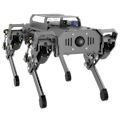
Is your Raspberry Pi still tucked away in a cabinet, quietly serving as a NAS or a home server? It's time to give it a body—one that can move, see, and interact. That's the core of my latest project: transforming PuppyPi, an open-source ROS quadruped robot designed for learning, into a genuinely practical prototype for a versatile home assistant. This isn't about remote control; it's about creating a mobile, intelligent agent that can patrol autonomously, understand commands, and even perform simple physical tasks. Here’s how I turned a development platform into a new member of the household.
Part 1: Why PuppyPi is the Raspberry Pi's "Final Form"The greatness of the Raspberry Pi lies in its limitless potential, yet its capabilities are often confined to the digital world. The PuppyPi perfectly addresses this by providing the missing piece: physical embodiment and interaction. It is, in essence, a high-precision robotic body tailor-made for the Raspberry Pi (especially the Pi 5/CM4).
Its sturdy CNC aluminum alloy frame and eight feedback-enabled smart servos provide a stable and reliable mobile base. Native support for ROS 1/2 means direct access to the vast open-source robotics ecosystem. Crucially, its modular design lets you expand its capabilities like building blocks: adding a HD wide-angle camera, a ToF LiDAR, and a 2-DOF robotic arm. This "trifecta" of expandability forms the hardware foundation for a home assistant: visual perception, spatial navigation, and physical manipulation.
Part 2: Building the Software Brain & Nervous System for a "Home Assistant"Hardware is the skeleton; software is the soul. I built the entire "central nervous system" based on ROS 2 (Humble Hawksbill). ROS's distributed node architecture is perfectly suited for such a complex project.
I created several core nodes that communicate via topics and services:
- navigation_core Node: Integrates LiDAR-based SLAM (I used Cartographer) with the ROS 2 Nav2 navigation stack. It's responsible for building a map of the home and planning collision-free paths.
- vision_brain Node: Runs an optimized YOLO model on the Pi to process camera data, enabling face recognition, pet detection, or identification of specific items (like keys or slippers).
- voice_interface Node: Integrates an offline speech recognition engine (like Vosk) for low-latency, local wake-word and command recognition—responsive and privacy-preserving.
- task_master Scheduler: This is the system's brain. It breaks down high-level natural language commands (e.g., "Go patrol") into specific task sequences and coordinates all other nodes to execute them.
🔥You can check PuppyPi tutorials or PuppyPi GitHub for code.Part 3: Deep Dive: Implementing Three Core Functions
Function 1: The Autonomous Security Sentry
This was the first function I implemented. The PuppyPi initiates patrol mode either on a preset schedule or via voice command. Using its LiDAR map, it moves between predefined points while its camera performs continuous visual analysis. I wrote a simple algorithm so that if it detects an unknown face, or via background subtraction notices an object that shouldn't be there (like a suddenly appearing package), it automatically takes a photo and sends an alert with the image to my phone via a Telegram Bot. This is far more flexible and proactive than a static camera.
Function 2: The Voice & Vision Interactive Companion
To make interaction more natural, I programmed several scenarios:
- "Come find me": When I call its name from another room, the voice_interface node recognizes it, and the vision_brain node, combining sound source localization and face search via the camera, guides it to walk up to me.
- "Go check...": Once I asked, "Is the balcony window closed?" It planned a path to the balcony, pointed the camera at the window, and after analysis by vision_brain, responded via speech synthesis: "The window is closed." This felt incredibly futuristic.
- Mobile First-Person View: I can remotely access its ROS system via a web interface on my phone to view the live camera feed and take manual control, achieving "remote presence."
This was the most complex but also the coolest function, requiring the addition of the 2-DOF robotic arm. First, I used AprilTag QR codes to mark common items (like the TV remote). When I say, "Bring me the remote, " the following sequence executes: The task_master dispatches it to navigate to the living room, vision_brain identifies the tag and calculates the item's 3D position, then calls the MoveIt! motion planning library to control the arm for grasping. Upon success, it navigates back to my location. After extensive tuning (especially on gripper force control), the success rate in a structured environment became very reliable.
Part 4: A Techie's Hardcore Review & Optimization GuideAfter weeks of development and debugging, here's a deep dive into the pros, cons, and fixes:
Advantages (Why It's Worth It):
- A True Full-Stack Learning Platform: You engage with every layer of robotics—from low-level serial servo control and mid-level ROS communication to high-level AI algorithms. The educational value is unparalleled.
- Unmatched Extensibility: The open-source hardware and software ecosystem means no ceiling. You can integrate almost any new package from the ROS community.
- Professional-Grade, Beyond Toys: The stability and durability from metal-gear servos and precision construction, unattainable by plastic toy platforms, make long-term development and feature iteration feasible.
Challenges & Real Solutions (The Pitfalls You Must Know):
- Battery Life Anxiety: Under full load (especially with both the arm and LiDAR operating), runtime is about 40-60 minutes. My solution was code optimization and implementing logic for an auto-docking charging station (using visual marker navigation).
- The Pi's Computational Limits: Running SLAM, a vision model, and navigation simultaneously is demanding for a Pi 5. I mitigated this by model quantization, using a more efficient model (YOLOv8n), and offloading some nodes to run on a home server, communicating via ROS 2's DDS for distributed computing. This significantly improved performance.
- The "Long Tail" of Home Environments: Low chair legs, reflective floors, and randomly placed slippers are all challenges. I adopted multi-sensor fusion, combining LiDAR data with depth information from the camera (or ultrasonic sensors), greatly improving obstacle avoidance robustness.
This project ultimately proves that PuppyPi can fully transcend its initial role as an educational tool, becoming a highly customizable, powerful prototype for a domestic agent. It's no longer a static device waiting for commands but an autonomous intelligent unit capable of active perception, movement, and influencing its environment. For makers and developers, the combination of PuppyPi and Raspberry Pi is arguably one of the best platforms available today for translating coding creativity into action in the physical world. It might not be a consumer-grade, out-of-the-box product, but it offers an unparalleled open experimental field for you to shape your vision of future home automation. My code and configuration are open-source. I look forward to seeing you create even cooler and more practical applications.


Comments