



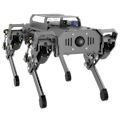
Imagine this: with a press of a switch, your robotic dog performs a smooth backflip, then uses a custom-built LEGO arm to hand you a drink. This isn't a lab prototype; it's a personalized project you can build, thanks to the deeply open-source MechDog.
Right out of the box, the MechDog declares it's different. This isn't a locked-down toy, but a open-source platform begging for reinvention. With its standardized ports, thorough API docs, and multi-environment programming support, it unlocks a world of personalized robotics for makers. Its core appeal? Delivering complete quadruped basics while handing all expansion potential directly to you. This guide will show you how to tap into that potential and build a uniquely capable robotic partner.
The Open-Source Core - Understanding the MechDog's DNAWhile most consumer robots are walled gardens, the MechDog takes the open-road. At its heart is an ESP32-S3 chip—powerful, and crucially, fully open. This grants direct access to hardware interfaces, allowing you to rewrite motion algorithms or even swap the control system entirely.
It welcomes all skill levels with three gateways: Scratch for beginners, Arduino for intermediates, and Python for pros. This multi-tiered design isn't just inclusive; it establishes the standardized protocols and interfaces that make expansion seamless.
Every servo has an independent ID and precise calibration. The control protocol for its 8 high-speed coreless servos is fully transparent. This openness lets you fine-tune pre-set moves and, more excitingly, invent entirely new gaits. It achieves near research-platform flexibility while remaining consumer-friendly.
The openness shines brightest in software. Official Python libraries, Arduino packages, and Scratch modules are all open-source—free to inspect, modify, and share.
You can check MechDog tutorials to get schematics, source code, video guides, etc.
This makes it a perfect educational tool. Teachers can build on existing code for lessons; students can tweak algorithms after grasping the basics. Advanced users can dive into modifying the inverse kinematics solver for advanced maneuvers.
In my tests, adding a simple ML module for camera-based gesture recognition was straightforward. No hacking needed—all sensor data and actuator controls are provided through standard APIs.
The modular design extends to hardware. The LEGO-compatible mounting holes are just the start. The main expansion port on the back offers 5V/3.3V power and multiple communication channels (UART, I2C, SPI), allowing direct plug-and-play with countless sensors and actuators.
I successfully connected ultrasonic sensors, IR arrays, a gyroscope, and a small gripper—no soldering required.
The LEGO Technic compatibility is exceptional, allowing for structurally sound, functional additions. I built a folding cargo platform, a rotating sensor mount, and flapping wings, all within an hour.
For serious custom work, even partial PCB design files are available, letting you create deeply integrated expansion boards—a rare privilege in consumer robotics.
Access Code: You can follow Hiwonder GitHub.Ecosystem Fusion - Bridging micro:bit and LEGO Worlds
The MechDog innovates by deeply integrating with micro:bit and LEGO ecosystems.
Paired with a micro:bit, it enables elegant layered control. The micro:bit acts as the "brain" for sensor logic and decisions, communicating via serial to the MechDog's ESP32, which handles the heavy lifting of motion control. This creates a flexible distributed system.
I implemented an environmental response demo: a micro:bit detects temps over 30°C, commands the dog to walk to a spot and sit, while its LED face shows a "hot" icon. This cross-device intelligence took mere dozens of lines of code.
Integration with LEGO unlocks physical creativity. The MechDog is engineered for LEGO expansion—its frame supports complex mechanisms, and its interfaces can power LEGO motors. I built a functional LEGO arm controlled via GPIO, enabling object pick-and-place tasks.
From Mods to Masterpieces - Project InspirationThe community has already built incredible projects. Here are three to spark your ideas:
- Personal Guide Dog Prototype: Add LiDAR/depth cameras and enhanced SLAM algorithms for autonomous navigation and mapping. This showcases upgrading a consumer bot to a research-grade platform.
- Interactive Art Installation: Combine the dog's mobility with LEGO sculptures to create kinetic art that reacts to audience movement. Modify LEDs and motion routines for new forms of expression.
- Modular Research Platform: Academia uses the MechDog as a low-cost quadruped research base. Its complete openness lets researchers focus on algorithms, not hardware fabrication.
For the ambitious, explore ROS integration, swarm behavior simulations, or even reinforcement learning for gait optimization. The MechDog bridges maker fun and academic research. It's increasingly found in classrooms, teaching not just coding, but systems thinking. On GitHub, enthusiasts share custom firmware, sensor drivers, and motion libraries.


Comments