



Hardware components | ||||||
 |
| × | 1 | |||
 |
| × | 1 | |||
 |
| × | 1 | |||
 |
| × | 1 | |||
 |
| × | 1 | |||
| × | 1 | ||||
Software apps and online services | ||||||
 |
| |||||
 |
| |||||
Autonomous mobile robots are becoming essential in modern industries, warehouses, hospitals, and smart buildings. While advanced navigation technologies such as LiDAR and SLAM offer excellent performance, they are often expensive and computationally intensive, making them impractical for educational projects and small-scale automation.
QR Code Follower Robot demonstrates a simpler yet powerful alternative. By placing QR codes along a predefined route, the robot can identify its location, interpret navigation commands, and move autonomously without requiring complex environmental mapping.
The project combines computer vision, embedded systems, and robotics into an affordable platform that showcases how visual markers can enable reliable autonomous navigation using off-the-shelf hardware.
The ProblemMany autonomous robots rely on sophisticated navigation systems that require costly sensors, extensive calibration, and significant processing power. These solutions present several challenges:
- High hardware costs due to LiDAR, depth cameras, or industrial sensors.
- Complex algorithms such as SLAM that demand powerful processors.
- Difficult deployment in environments where maps frequently change.
- Limited accessibility for students, makers, and educational institutions.
- Traditional line-following robots lack flexibility and can only follow fixed paths without understanding destinations or instructions.
As a result, there is a need for a navigation system that is:
- Low-cost
- Easy to deploy
- Simple to maintain
- Intelligent enough to make navigation decisions
- Suitable for education and rapid prototyping
QR Code Follower Robot addresses these challenges by using computer vision as its primary navigation sensor.
A camera continuously scans the environment for QR codes placed on the floor or at strategic checkpoints. Each QR code contains navigation information such as:
- Move Forward
- Turn Left
- Turn Right
- Stop
- Destination ID
- Checkpoint Number
- Route Information
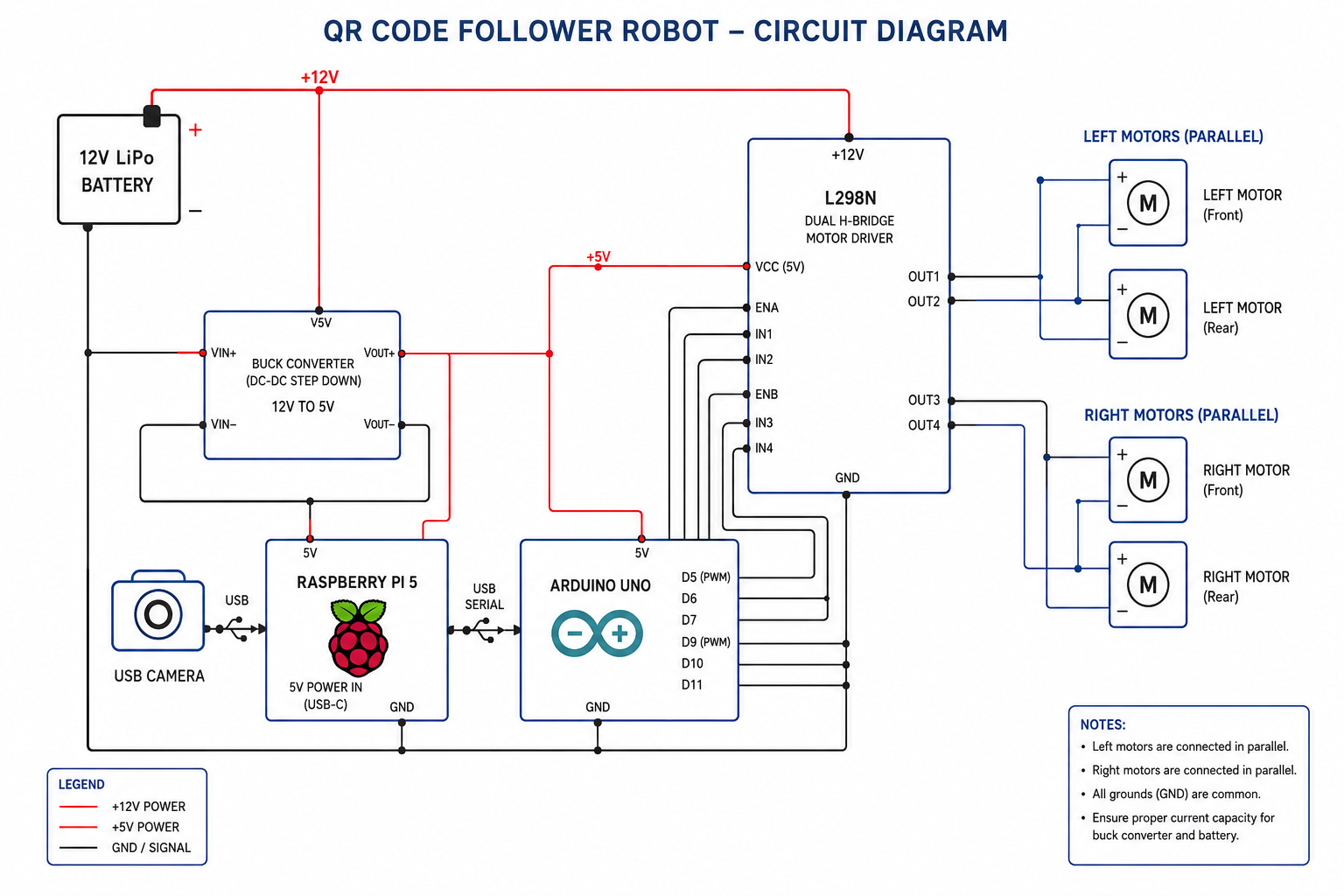
The captured image is processed on a Raspberry Pi, where OpenCV decodes the QR code and determines the next movement command. The Raspberry Pi then communicates with an Arduino, which performs real-time motor control, ensuring smooth and accurate robot movement.
The navigation workflow is simple:
- Camera captures the QR code.
- Raspberry Pi processes the image using computer vision.
- QR code is decoded into navigation instructions.
- Arduino executes motor commands.
- Robot moves to the next checkpoint.
- Process repeats until the destination is reached.
This architecture separates high-level vision processing from low-level motor control, resulting in a responsive and modular robotic system.
Key Features- Real-time QR code detection
- Computer vision-based navigation
- Raspberry Pi image processing
- Arduino motor control
- Modular hardware architecture
- Low-cost implementation
- Easy deployment without mapping
- Scalable for warehouses, laboratories, and educational robotics
- Smart warehouse navigation
- Automated material transport
- Educational robotics
- Indoor delivery robots
- Factory logistics
- Hospital service robots
- Museum or exhibition guides
- Research on autonomous navigation
By replacing expensive localization technologies with inexpensive printed QR codes and computer vision, this project demonstrates that autonomous navigation can be made affordable, accessible, and scalable. It provides an ideal platform for learning robotics while offering a practical solution for structured indoor environments where reliability, simplicity, and cost-effectiveness are essential.
See the video


Comments