



Hardware components | ||||||
 |
| × | 1 | |||
 |
| × | 1 | |||
 |
| × | 1 | |||
Software apps and online services | ||||||
 |
| |||||
Hand tools and fabrication machines | ||||||
| ||||||
This Automatic Toll Gate System Project Using Arduino demonstrates how to build a fully automated toll gate system using an Arduino Uno, RFID technology, IR sensors, and a servo motor to handle vehicle detection, payment processing, and gate control — all without manual intervention. It’s a hands-on, beginner-friendly project that mimics real-world toll operations and introduces you to integrating sensors, actuators, and identification systems with microcontrollers.
The system models an automatic toll collection setup:
- Vehicle Arrival – An IR sensor placed at the entrance detects the approach of a vehicle.
- RFID Authentication – When a vehicle stops, the driver presents an RFID card to the RC522 reader. The Arduino reads the unique ID and compares it to the stored values.
- Balance Verification – If the card is recognised and has sufficient balance, the toll amount is deducted. Otherwise, access is denied.
- Gate Control – On successful payment, a servo motor lifts the gate. A green LED indicates approval; a red LED shows denial.
- Exit Detection – A second IR sensor detects when the vehicle passes through, after which the gate closes, and the system resets for the next vehicle.
This workflow simulates a real toll booth where vehicles are automatically served as they arrive, reducing congestion and human effort.
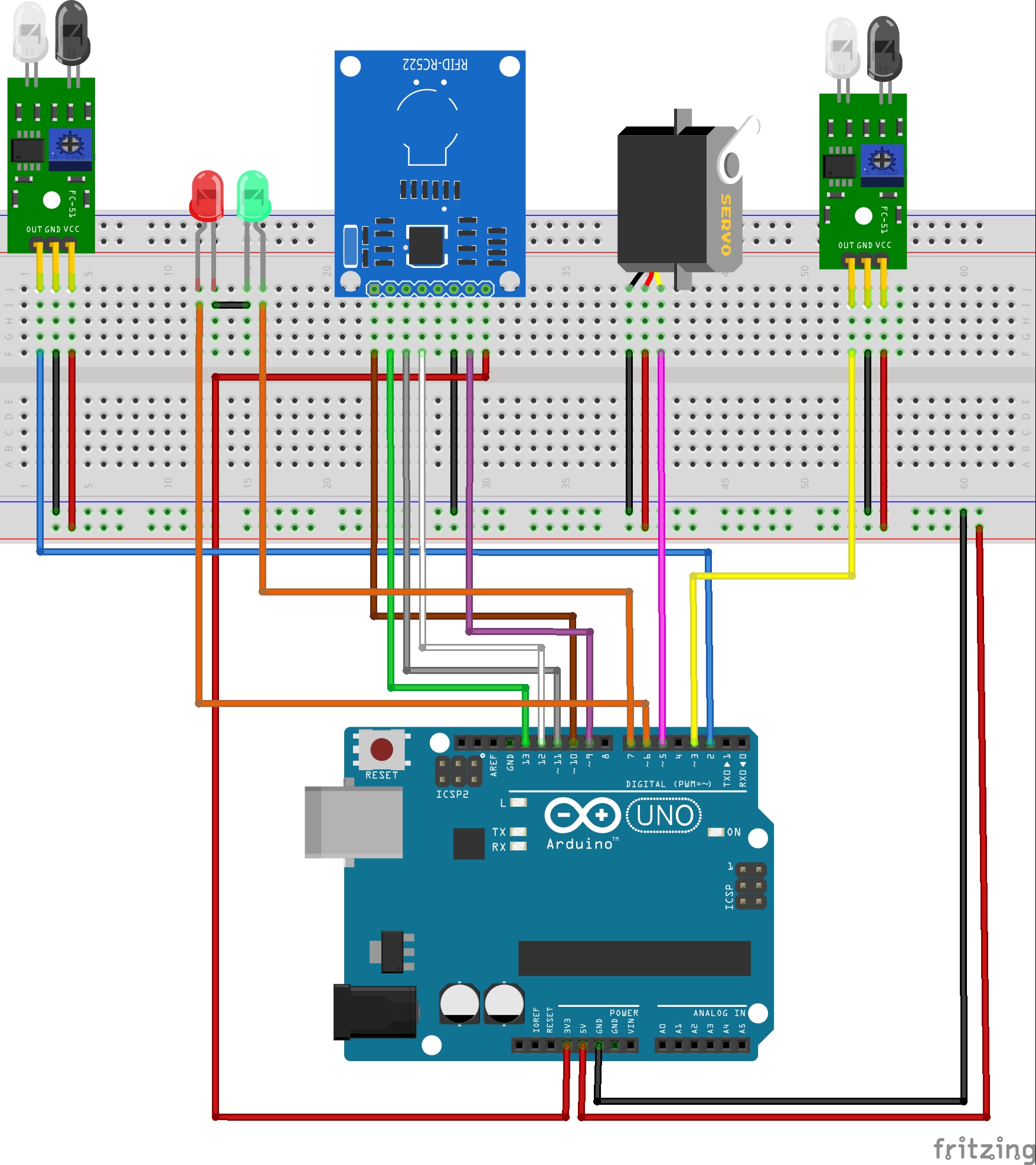
- RFID Reader: SPI interface to Arduino digital pins.
- IR Sensors: Connected to digital input pins to sense approaching and exiting vehicles.
- Servo Motor: Connected to a PWM pin to rotate and open/close the gate.
- LEDs: Output pins to show system status.
Wiring the components correctly ensures reliable detection, authentication, and actuation.
The Arduino sketch integrates libraries like:
SPI.h— for communicating with the RFID module.MFRC522.h— for RFID operations.Servo.h— for controlling the gate motor.
The logic includes:
- Hardware initialisation and sensor setup.
- Continuous loop waiting for vehicle detection.
- RFID read and comparison with stored IDs.
- Balance check and gate actuation on success.
- Resetting LEDs and the gate for the next vehicle.
This structure teaches how to handle real-time inputs and outputs with a microcontroller.
Real-World ApplicationsBeyond toll booths, this system’s design can be adapted for:
- Parking lot automation (entry/exit control via cards).
- Residential or office access control systems.
- Industrial gates with secure vehicle authorisation.
- Smart campuses with automated vehicle tracking.
Once the core system works, you can enhance it with:
- LCD or OLED displays showing balance and status.
- IoT connectivity to log transactions and update balances online.
- Database integration to handle many users and dynamic pricing.
- Security upgrades like encryption or NFC support.

_3u05Tpwasz.png?auto=compress%2Cformat&w=40&h=40&fit=fillmax&bg=fff&dpr=2)
Comments