



Hardware components | ||||||
 |
| × | 1 | |||
| × | 1 | ||||
Software apps and online services | ||||||
 |
| |||||
Air pollution has become one of the most significant environmental challenges of modern cities. Rising levels of particulate matter, especially PM2.5 and PM10, pose serious risks to human health, contributing to respiratory diseases, cardiovascular problems, and reduced life expectancy. In response to these concerns, low-cost and accessible air quality monitoring systems are increasingly important. This project presents a compact, real-time air quality monitoring system based on the Wio Terminal and a PM2.5 laser dust sensor.
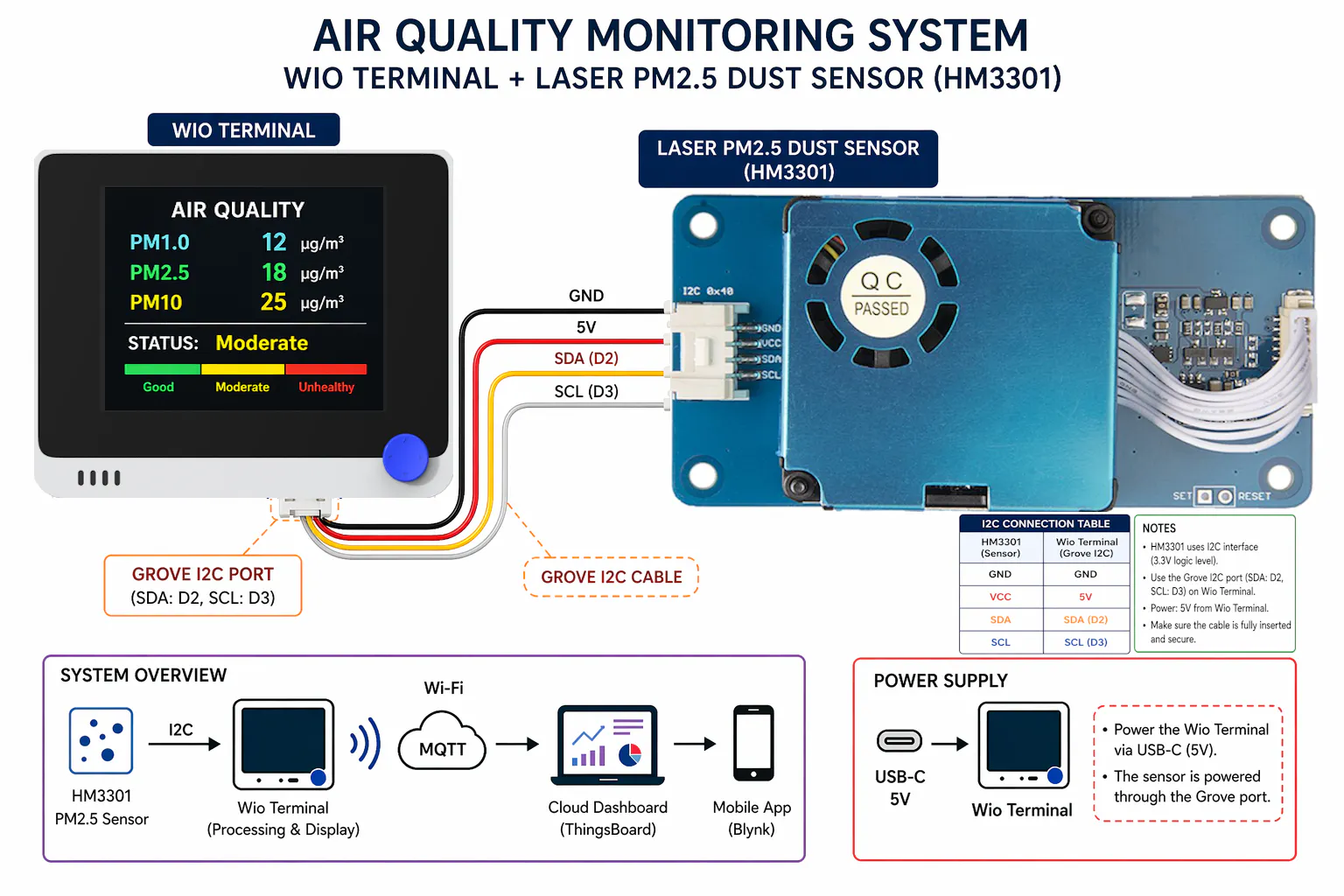
This project focuses on building a compact and portable air quality monitoring system using the Wio Terminal (ATSAMD51 with integrated Wi-Fi and BLE) and the Grove PM2.5 Dust Sensor (HM3301). The system measures particulate matter concentrations (PM1.0, PM2.5, and PM10) in real time and displays the data locally while also transmitting it wirelessly for remote monitoring.
The goal is to provide users with accessible, real-time information about air pollution levels, which is especially relevant in urban environments where air quality can fluctuate significantly.
The core of the system is the Wio Terminal, a powerful microcontroller platform equipped with an ATSAMD51 processor, built-in LCD display, and integrated Wi-Fi and Bluetooth connectivity. Its design allows it to function as a standalone edge-computing device, capable of processing sensor data and transmitting it wirelessly. This makes it particularly suitable for environmental monitoring applications where portability and real-time performance are essential.
The air quality data is collected using the Grove - Laser PM2.5 Dust Sensor HM3301, which is based on laser scattering technology. This sensor measures the concentration of particulate matter in the air, including PM1.0, PM2.5, and PM10. These values represent particles of different sizes, with PM2.5 being especially dangerous due to its ability to penetrate deep into the lungs. The sensor provides continuous and accurate measurements, making it ideal for environmental monitoring systems.
In this project, the sensor communicates with the Wio Terminal via a I2C interface. The microcontroller reads raw data from the sensor, processes it, and converts it into meaningful environmental indicators. The system applies simple classification logic to determine air quality levels, such as “Good, ” “Moderate, ” or “Unhealthy, ” based on PM2.5 concentration thresholds. This allows users to easily interpret the data without requiring technical knowledge.
A key feature of the system is its real-time visualization capability. The Wio Terminal’s built-in LCD screen displays current air quality readings, including PM values and status indicators. This provides immediate feedback to users in the monitored environment. Additionally, the system can be extended with wireless communication features, enabling data transmission over Wi-Fi to cloud platforms for remote monitoring and long-term analysis.
From a broader perspective, this type of embedded system demonstrates how Internet of Things (IoT) technologies can be applied to environmental protection. By combining sensors, microcontrollers, and wireless communication, it is possible to create distributed networks of air quality monitoring devices. Such systems can contribute to smart city infrastructure, helping authorities and citizens make informed decisions about environmental conditions.
Hardware ComponentsMain Controller - Wio TerminalA powerful microcontroller board featuring:
- ATSAMD51 core (120 MHz ARM Cortex-M4F)
- Built-in LCD display
- Integrated Wi-Fi (2.4G/5G) and BLE (RTL8720DN)
- USB-C connectivity
- Grove interface for easy sensor integration
A laser-based sensor capable of detecting:
- PM1.0
- PM2.5
- PM10
It uses light scattering technology to estimate particle concentration in µg/m³.
System ArchitectureThe system consists of three main layers:
1. Data AcquisitionThe HM3301 sensor continuously measures airborne particles. It communicates with the Wio Terminal via a I2C interface.
2. Data ProcessingThe Wio Terminal:
- Reads raw sensor data
- Parses the measurement frames
- Converts values into human-readable units (µg/m³)
- Applies basic filtering (e.g., moving average) to reduce noise
- Local display: real-time values shown on the built-in LCD
Wireless transmission:
- Wi-Fi: sends data to a cloud platform (e.g., MQTT, HTTP server)
- BLE: optional connection to a mobile app
- Arduino IDE or PlatformIO
Required libraries:
- I2C Sensor communication library
- Wi-Fi and networking libraries for the RTL8720DN module
Sensor Interface Module
- Initializes the HM3301
- Reads measurement frames
- Validates checksum
Data Processing Module
- Extracts PM1.0, PM2.5, PM10 values
- Applies smoothing algorithms
Display Module
Updates LCD with:
- Current PM values
- Air quality category (e.g., Good, Moderate, Unhealthy)
Communication Module
Sends data via Wi-Fi to:
- Cloud dashboards (e.g., ThingsBoard, Blynk)
- REST API endpoints
- Optional BLE broadcasting
Moreover, the project has educational value. It introduces fundamental concepts of embedded systems, sensor integration, and data communication. Students and developers can learn how physical measurements are transformed into digital data, processed in real time, and visualized for practical use. This makes the system not only functional but also an effective learning platform for engineering and environmental science disciplines.
ConclusionIn conclusion, the air quality monitoring system based on the Wio Terminal and HM3301 sensor provides a practical, scalable, and educational solution for tracking environmental pollution. It demonstrates how modern microcontroller platforms can be used to address real-world problems in a simple yet powerful way. As air pollution continues to be a global concern, such systems will play an increasingly important role in raising awareness and supporting data-driven environmental action.


Comments