



Hardware components | ||||||
| × | 1 | ||||
| × | 1 | ||||
| × | 1 | ||||
| × | 1 | ||||
| × | 1 | ||||
Software apps and online services | ||||||
| ||||||
Hand tools and fabrication machines | ||||||
| ||||||
 |
| |||||
 |
| |||||
MagPod is a compact, rechargeable, 3D-printed Bluetooth speaker designed to combine portability, magnetic mounting, and TWS stereo capability in a small enclosure.
The project uses a 27 mm 4Ω 3W speaker together with a Bluetooth 5.4 TWS mono amplifier module. The enclosure is designed to hold the Bluetooth board, rechargeable battery, speaker, and 3 × 6 mm neodymium magnets while keeping the overall size compact.
The magnets are inserted into the enclosure during the 3D-printing process by pausing the print at the required layer. This allows the magnets to remain hidden inside the printed part and creates a clean integrated design.
After printing, the Bluetooth module is installed inside the enclosure, connected to the rechargeable 3.7V battery, and wired to the speaker. The battery and electronic components are secured inside the enclosure before final assembly.
The speaker can be used individually as a compact Bluetooth speaker, or two MagPod units can be paired using TWS to create left and right stereo channels.
The magnetic design also allows the speaker to attach to suitable metal surfaces and compatible magnetic phone mounts.
Main Features- Bluetooth 5.4
- TWS stereo pairing
- 27 mm 4Ω 3W speaker
- Rechargeable 3.7V battery
- USB-C charging
- Magnetic mounting
- 3 × 6 mm neodymium magnets
- Compact 3D-printed enclosure
- AUX input
- Built-in power switch
The enclosure is printed in separate parts. During printing, the machine automatically pauses at the specified layer so the magnets can be inserted before the print continues.
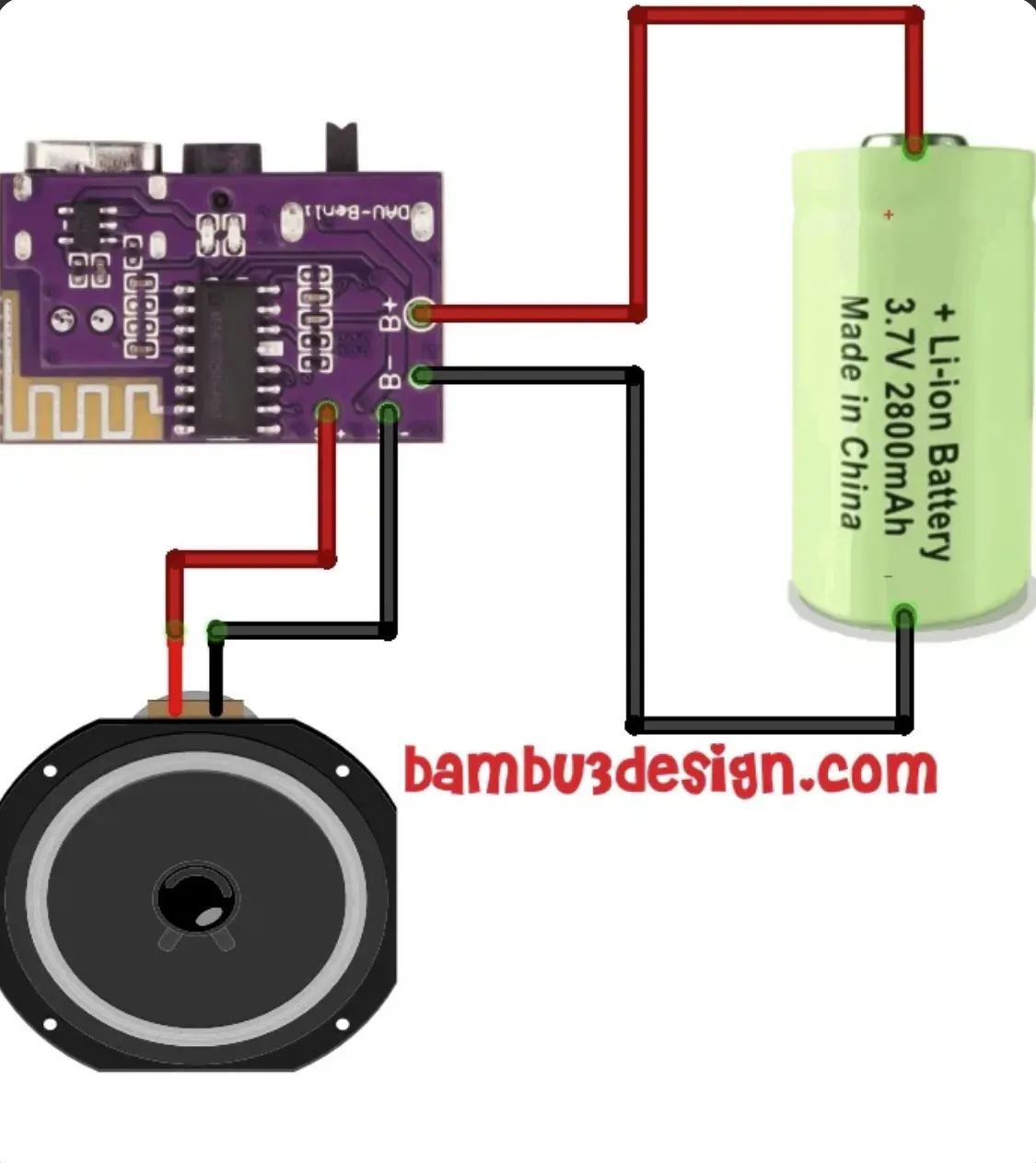
Electronics AssemblyThe Bluetooth module is connected to the rechargeable battery and speaker according to the wiring diagram. Kapton tape is used to insulate exposed battery terminals, and hot glue is used where necessary to secure the components.
TWS ConnectionA single MagPod can operate independently. Two units can also be paired through TWS to create a wireless stereo setup with separate left and right channels.
Files and Full Build VideoThe complete build process, including 3D printing, magnet insertion, wiring, assembly, TWS pairing, and final testing, is available in the full video tutorial.


Comments