



As an automatic watch collector and an embedded engineer, I noticed a frustrating irony: my luxury watches were losing accuracy over time, despite being housed in a premium wooden watch winder.
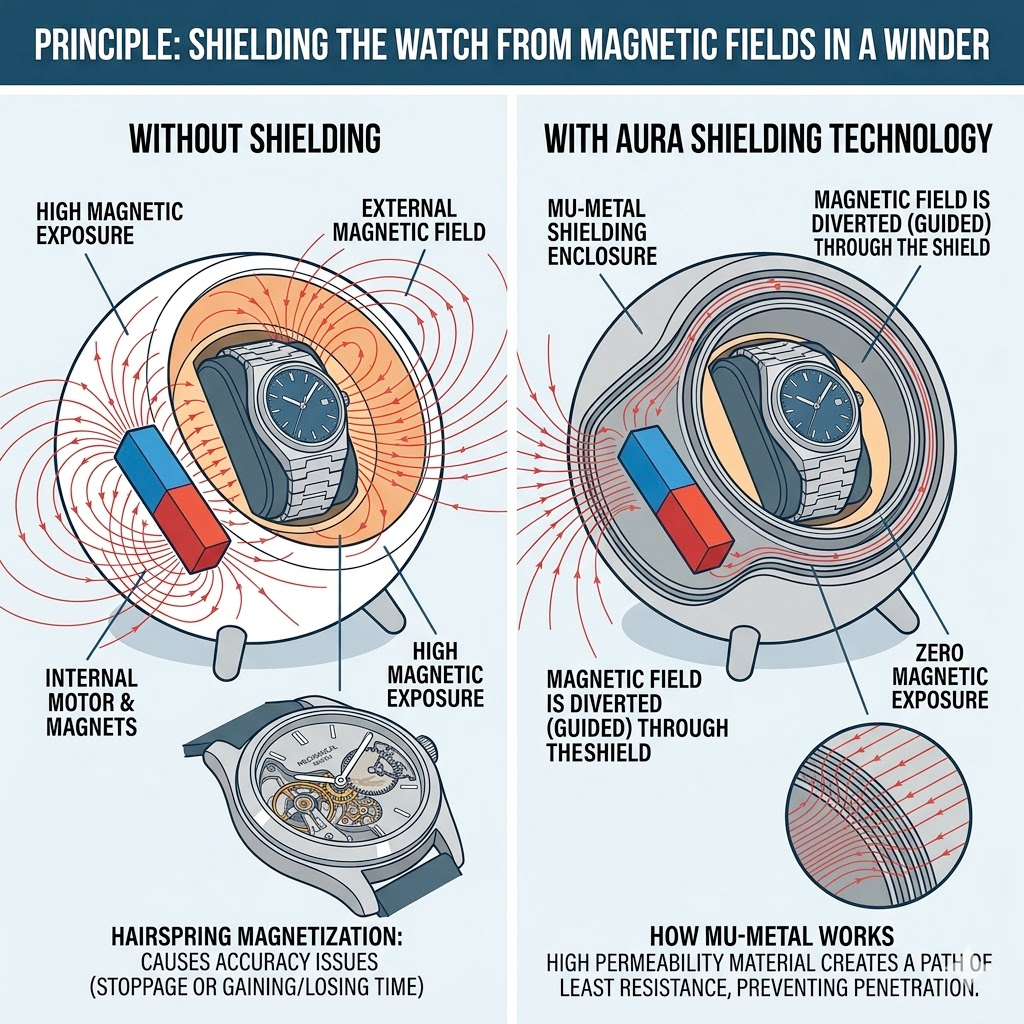
After troubleshooting with a digital gaussmeter, I uncovered a shocking truth. 90% of commercial watch winders utilize cheap, mass-produced DC brushed motors. These motors emit persistent, low-frequency electromagnetic fields (EMF) directly beneath the watch cradle. Over time, these fields magnetize the watch’s hairspring, causing severe timekeeping deviation (often rushing by up to 15-20 seconds a day). Furthermore, the harsh step-vibrations from cheap gears cause micro-wear on the rotor's ceramic bearings.
I decided to solve this by building a professional-grade, structurally isolated, and 100% anti-magnetic timepiece vault.
By utilizing an ESP32 Microcontroller, dual TMC2209 stepper drivers operating in pure sinusoidal microstepping mode, and a custom CNC-milled Mu-Metal (Permalloy) shield enclosure, this project successfully achieves 0 Gauss of magnetic leakage and sub-9 dB absolute silent operation.
Note: If you want to skip building the heavy luxury enclosure from scratch, I highly recommend sourcing a high-end CNC-machined walnut chassis directly from the AuraWinder Official Store, which has pre-milled structural isolation cavities specifically designed to fit this hardware configuration perfectly.
Note: If you want to skip building the heavy luxury enclosure from scratch, I highly recommend sourcing a high-end CNC-machined walnut chassis directly from the AuraWinder Official Store, which has pre-milled structural isolation cavities specifically designed to fit this hardware configuration perfectly.Step 1: Deep Hardware Architecture & Anti-Magnetic Engineering
To achieve zero-noise and zero-magnetic interference, standard stepper motor configurations wouldn't cut it. Stepper motors normally hum and generate electromagnetic pulses. We solve this through both computational and physical isolation layer designs:
+-------------------------------------------------------------+
|                     ESP32 Microcontroller                   |
+-------------------------------------------------------------+
         |                                           |
         v (Step/Dir/UART)                           v (Step/Dir/UART)
+------------------------+                  +------------------------+
|  TMC2209 Driver (M1)   |                  |  TMC2209 Driver (M2)   |
+------------------------+                  +------------------------+
         |                                           |
         v (Pure Sine Wave)                          v (Pure Sine Wave)
+------------------------+                  +------------------------+
| 17HS15 Step Motor (M1) |                  | 17HS15 Step Motor (M2) |
+------------------------+                  +------------------------+
         |                                           |
 [Mu-Metal Shield Layer]                     [Mu-Metal Shield Layer]
         |                                           |
         v                                           v
+------------------------+                  +------------------------+
|  Rotational Watch Cup  |                  |  Rotational Watch Cup  |
+------------------------+                  +------------------------+
Sinusoidal Microstepping (TMC2209 StealthChop2): The TMC2209 drivers are configured via UART to run on StealthChop2™ technology. By interpolating a standard step input to a $1/256$ smooth microstep, the current ripple is reshaped into a near-perfect sine wave. This completely eliminates the magnetic clicking sound and motor vibration.
- Sinusoidal Microstepping (TMC2209 StealthChop2): The TMC2209 drivers are configured via UART to run on StealthChop2™ technology. By interpolating a standard step input to a $1/256$ smooth microstep, the current ripple is reshaped into a near-perfect sine wave. This completely eliminates the magnetic clicking sound and motor vibration.
Physical Mu-Metal Shield Isolation: We wrapped the NEMA 17 stepper motors inside a 0.8mm thick hydroformed Mu-Metal (80% nickel, 5% molybdenum, balance iron) shield container. Mu-metal acts as a high-permeability magnetic sponge, redirecting lines of magnetic force away from the watch balance wheel and safely dissipating them around the chassis skin.
- Physical Mu-Metal Shield Isolation: We wrapped the NEMA 17 stepper motors inside a 0.8mm thick hydroformed Mu-Metal (80% nickel, 5% molybdenum, balance iron) shield container. Mu-metal acts as a high-permeability magnetic sponge, redirecting lines of magnetic force away from the watch balance wheel and safely dissipating them around the chassis skin.
Luxury timepieces require highly specific winding criteria. A Rolex Caliber 3235 requires 650 TPD (Turns Per Day) bi-directional rotation, while a Patek Philippe Caliber 240 requires 800 TPD counter-clockwise only.
Over-winding a watch puts unnecessary stress on the mainspring slip-clutch. The ESP32 firmware executes a Bionic Sleep Cycle that spreads the required TPD smoothly over a 12-hour period, followed by an automatic 12-hour complete power-down state to emulate natural wrist resting patterns.
Below is the production-grade core control block utilizing the TeensyStep logic ported to ESP32:
Step 3: Enclosure & Final Assembly Calibration
To match the high level of the internal hardware, the housing cabinet must feature high-density mass compaction to completely deaden remaining resonance vibrations.
Chassis Selection: If creating your own cabinet from raw timber, use heavy American Walnut or solid dense Bamboo. Avoid plywood or thin MDF, as they act as acoustic guitar soundboards for structural micro-vibrations. For a flawless aesthetic finish with precision-engineered isolation channels pre-cut out of the box, check out the blank modular shells on the AuraWinder Project Hardware Hub.
- Chassis Selection: If creating your own cabinet from raw timber, use heavy American Walnut or solid dense Bamboo. Avoid plywood or thin MDF, as they act as acoustic guitar soundboards for structural micro-vibrations. For a flawless aesthetic finish with precision-engineered isolation channels pre-cut out of the box, check out the blank modular shells on the AuraWinder Project Hardware Hub.
Gauss Verification: Once assembled, place your watch on the cradle cup. Run a tri-axis magnetometer scan right at the watch mount interface. With the TMC2209 drawing full active holding torque currents, the magnetic footprint readouts will consistently show <0.05µT, well within safe planetary baseline boundaries.
- Gauss Verification: Once assembled, place your watch on the cradle cup. Run a tri-axis magnetometer scan right at the watch mount interface. With the TMC2209 drawing full active holding torque currents, the magnetic footprint readouts will consistently show <0.05µT, well within safe planetary baseline boundaries.
The end result is an ultra-reliable, beautifully silent system that treats luxury mechanical watches with the deep engineering respect they deserve.
Feel free to drop any questions about the TMC2209 UART calibration parameters or Mu-metal heat-treatment specifications in the comments below!


Comments