At UniLaSalle Amiens, we are surrounded by dozens of classrooms and study areas. However, a common frustration for students is wandering the hallways in search of a quiet place to work, only to find rooms that are "officially" booked but completely empty—so-called "ghost reservations." Conversely, finding an empty room often feels like a gamble, with no way of knowing if a class is scheduled to start five minutes later.
This inefficiency in space management sparked our project. We realized that the gap between the school’s digital schedule and the physical reality of the rooms could be bridged using the Internet of Things.
The Evolution of the ConceptWe didn't just want to see if a room was occupied; we wanted to transform how students and faculty interact with the campus infrastructure.
Solving the Search: By integrating a PIR sensor, our device provides real-time occupancy data to a centralized web application, allowing students to instantly locate a truly "free" room from their smartphones.
Solving the Search: By integrating a PIR sensor, our device provides real-time occupancy data to a centralized web application, allowing students to instantly locate a truly "free" room from their smartphones.
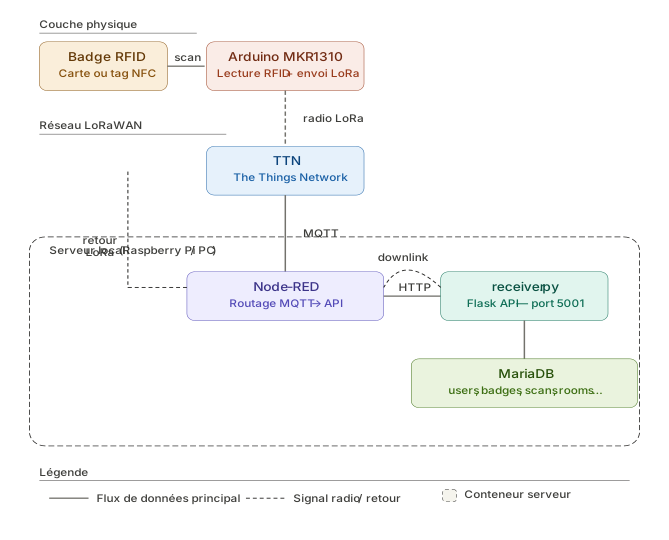
Streamlining Administration: To add professional value, we integrated an RFID reader. Instead of wasting time with manual paper attendance sheets, students simply "tap" their badges to emendate for TDs and TPs.
Streamlining Administration: To add professional value, we integrated an RFID reader. Instead of wasting time with manual paper attendance sheets, students simply "tap" their badges to emendate for TDs and TPs.
Closing the Loop: Through LoRaWAN technology, the system remains low-power and long-range, ensuring it can be deployed across the entire campus without complex wiring.
Closing the Loop: Through LoRaWAN technology, the system remains low-power and long-range, ensuring it can be deployed across the entire campus without complex wiring.
What started as a struggle to find a peaceful place to study has become a comprehensive demonstrator for a Smart Campus. By housing our electronics in a custom 3D-printed enclosure and connecting them to a Linux-based server, we’ve moved from a simple idea to a functional solution that respects the constraints of modern IoT: low power, high efficiency, and real-world utility.






Comments