



Hardware components | ||||||
| × | 2 | ||||
 |
| × | 3 | |||
 |
| × | 3 | |||
 |
| × | 1 | |||
 |
| × | 3 | |||
 |
| × | 2 | |||
 |
| × | 2 | |||
 |
| × | 12 | |||
Software apps and online services | ||||||
| ||||||
| ||||||
| ||||||
Hand tools and fabrication machines | ||||||
 |
| |||||
 |
| |||||
After the Global Topsoil Depletion of 2080, agricultural supply chains stalled, then collapsed. Crop failures cascaded across continents, famine redrew borders, and mass extinction accelerated beyond prediction. Many nations turned to hydroponics and aquaponics, but over time the absence of soil-based microbial ecologies led to widespread immune disorders.
The few communities that survived relied on a once overlooked practice: composting. Through hyperlocal compost systems, they restored soil health using organic waste streams. Healthy compost became a non-negotiable condition for survival. Daily life revolved around careful tending: balancing carbon and nitrogen inputs, monitoring moisture, aerating piles by hand, and adjusting diets to stabilize decomposition cycles. There was little margin for error; compost was managed through sensors, dashboards, alerts, and predictive AI models.
A group of designers in the The Iberian Autonomous Survival Regions began to question this model of management, arguing that optimization and remote control reproduced the extractive mindset that had caused the crisis in the first place. Rather than monitor compost from a distance, they sought continuous attunement. They began to create wearable exo-organs that provided an embodied awareness of compost health, abandoning screens and dashboards in favor of sensation. What followed was unexpected. Over time, the compost no longer felt external. The needs of the pile began to feel inseparable from the needs of the body.
What began as a fringe practice spread across regions, in part because these communities produced more stable soil and more resilient food systems. The devices, soon known as the Second Spine, became integral to daily life. They were repaired, modified, and passed down alongside compost itself, which families maintained across generations as both inheritance and responsibility. Children were gifted their first Second Spine once they learned to walk. Over time, the distinction between human and compost blurred. Compost lineage and family lineage became intertwined. From this entanglement emerged a new species. Historians would later name them Compborgs, the first Homo sapiens to abandon the boundary between body and soil.
Research Question:How can we create an exo-organ that allows the wearer to “feel” compost in order to deepen the connection between people and their compost?
Project Concept:Compborg Second Spine is a speculative yet functional exo-organ that allows a human to physically sense the health of compost. Using environmental sensors and haptic feedback, the system translates compost conditions into bodily sensation. The project explores what it would mean to merge with the systems that sustain us, reframing compost not as waste infrastructure but as a shared metabolic partner.
Team:Lo Willihnganz - Hardware & Fabrication
(Lo's website under construction-- in conversation with Chiara)
Ayal Bark - Software & System Logic
Bill of Materials (BOM):See the “Things” section above for the full Bill of Materials, including hardware, software, fabrication materials, and tools used in this project.
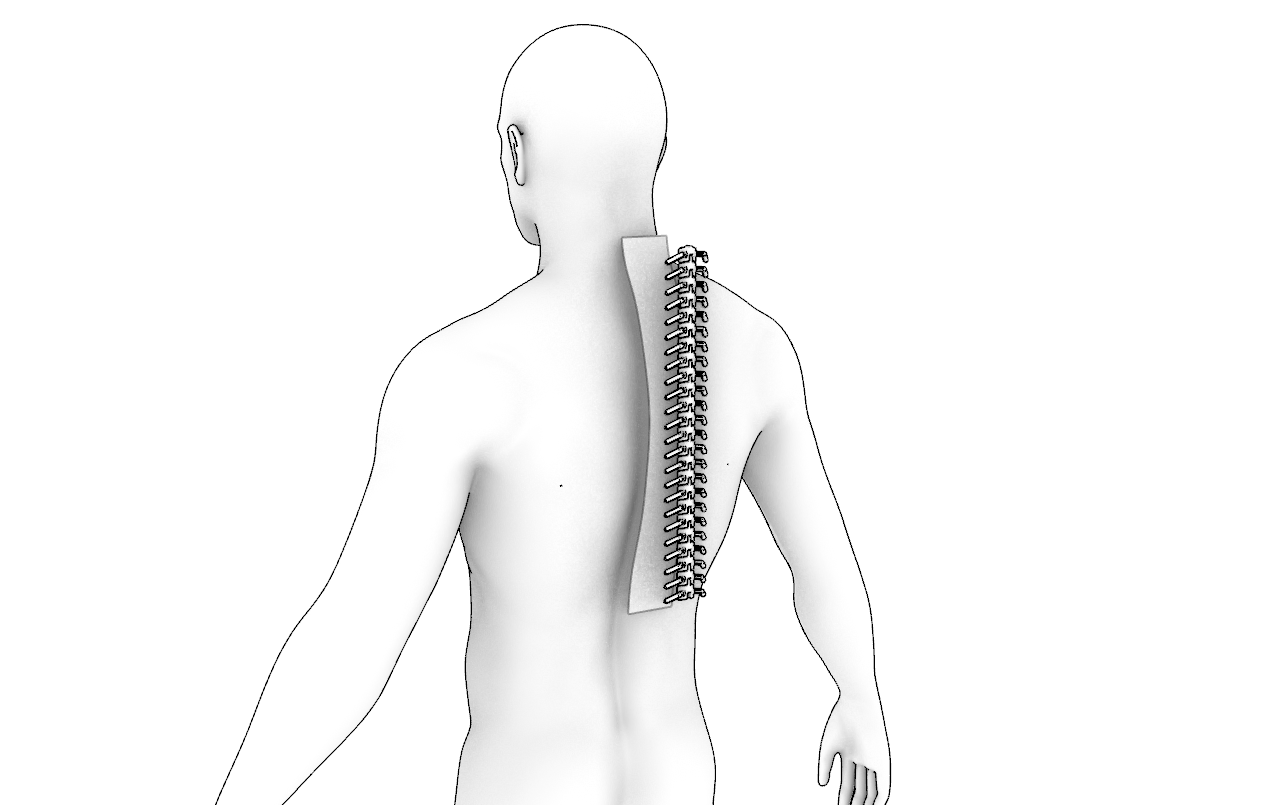
Fabrication Process:The design form was taken from a common compost critter: the centipede. After deciding the spine was the best place to put the haptic motors, the process began by 3D modeling in Rhino. To see how the 3D printer would work, and to attain a better understanding of the project on a physical and experiential level, the first prototype was a small test of 5 vertebra using articulated joinery.
Later, we considered doubling the size of the prototype in order to be able to insert the haptics into the material, but then decided that the scale was far to big and the printing process would take more time than we had. We compromised with making the spine/centipede longer, with the same amount of vertebra as there are in humans.
The longer spine would require us to solder longer wires for the haptics. We would then weave them through each external "leg" of the centipede, and glue the 3 haptics to the bottom.
The feat to make it to the final prototype was a difficult one. After 5 attempts of 3D printing fails, we concluded that the filament was too old. Once we replaced it, the print turned out perfectly.
Integrated Design (System Diagram):The Second Spine is made out of two different nodes: the compost node which reads the moisture levels of the compost, and the motor node which translates the moisture readings into real time haptic feedback.
Below are the wiring schematics of each node.
The Compost Node is incredibly simple. It consists of the soil moisture sensor connected to the raspberry pi pico 2 w.
VCC is connected to SYSV on the Pico
GND is connected to GND on the Pico
In this schematic, SIG is connected to GPIO16 on the Pico.
For our node we are using a sensor with AO and DO outputs, and have the DO unconnected. Our AO is connected to GPIO16.
The schematic makes it look unbelievably more complicated than it is. Here's what's happening:
A jumper wire is connecting SYSV to + on the breadboard
A jumper wire is connecting GND (third to bottom pin on the right) to the - column of the breadboard
All of the + ends of the motors are terminating in the + column of the breadboard
Each of the - ends of the motors are terminating in the collector pin of a transistor (NOTE: in the schematic it shows they are connected to the emitter pin. I decided to keep the schematic relevant to the transistors I had on hand, which are ordered differently. It is the connector, NOT the emitter pin).
Each of the base pins of the transistor are connected to a 220 Ω resistor, which is then connected to a jumper wire connecting it to it's respective GPIO pin.
Each of the emitter pins of the transistor are connected to the - column of the breadboard
Quick Cheatsheet:
- SYSV —> + column of breadboard
- GND —> - column of breadboard
- motor + —> + column
- motor - —> collector on transistor
- transistor base - 220k resistor - relevant pin
- transistor emitter —> - column
Here is an overview of the design process broken up into each of the 3 Days. Check the attachments for relevant portions of code written in parenthesis below (like this).
Day 1:
(1) We started with an unused Parrot Flower Power Sensor. The idea was to use it as our sensing agent. The product has been discontinued for years, so there was no easy way to access the data. While there was a work around available, we realized that for an MVP this was going to be both (1) massive overkill for what we need, and (2) way more complicated than we need it to be from a software perspective.
(2) We decided to switch to a normal soil moisture sensor to gather data from the compost for our MVP.
(3) Collected Hardware (see Things section above) and Resources (see Resources section below).
(4) Started looking for cyborg inspiration and thinking about where on the body is best
(5) Made sure both raspberry pis worked by testing their LEDs (blink.py)
(6) Got the Soil Sensor set up (compost_test.py)
(7) Places the sensor into different conditions while reading serial output to approximate the different ranges of moisture levels.
(8) Got a single motor to work (no coding - just plugged it into SYSV and GND).
(9) Printed out the first prototype of the spine
Day 2:
(7) Came back the next morning with some coffee.
(7.1) Began designing the new wearable in rhino, considering scale and length
(8) Got the raspberry pi picos to talk to each other
(8.1) Got the IP of the raspberry pi we in the Motor Node (reciever_test.py)
(8.2) Got the raspberry pi in the Compost Node to send numbers over wifi:
Ran both of these at the same time:
(sender_test.py) on Compost Node
(receiver_test(full).py) on Motor Node
(9) Got multiple motors to work (motor_test.py)
(10) Got the sensor node to affect the motor node
Ran both of these at the same time:
(main(compostnode).py) on Compost Node
(main(motornode).py) on Motor Node
**Once you put these onto the Raspberry Pi, if you want them to run immediately on boot (without a computer to prompt it), you NEED TO SAVE THE CODE as "main.py". Nothing else. Not even the stuff in parenthesis. We used Thonny (software) to do this, as it is much more straightforward than Cursor.
(11) Began the final wearable spine, failed. Switched machines, failed. Changed file, failed. Let it rest for the day, praying that tomorrow will be better.
Day 3:
(12) Printed Final wearable Spine with new filament
(12.2) Disassembled the prototype
(13) Soldered the jumper wires together (We didn't know we had access to long continuous cables in the FabLab. If we did it again, we would use those instead. But, we're glad we didn't know, because it was fun to get more practice soldering.)
(14) Added heat shrink around the exposed wires.
(15) Assembled the second prototype
(16) Made sure the motors worked on the new prototype, and started playing around with different haptic patterns. Ran code that would let us test the haptic patterns without relying on moisture readings from the Compost Node (main(receivertest).py)
(17) Put the prototype onto a human and photographed the real-life placement of it
(18) Documented the process and created presentation
- https://github.com/matta-pie/MDEF-DesigningWithExtendedIntelligence (Used this to set up pico w2)
- https://www.raspberrypi.com/documentation/microcontrollers/pico-series.html#pico2w-technical-specification (raspberry pi pico 2 tech specs)
- https://datasheets.raspberrypi.com/picow/pico-2-w-pinout.pdf (pico 2 pinout)
- https://datasheets.raspberrypi.com/picow/pico-2-w-schematic.pdf (pico 2 w schema)
- https://www.tiendatec.es/electronica/componentes/transistores/2093-transistor-2n2222-npn-8472496022491.html (transistor datasheet)
Donna Haraway – Cyborg Manifesto
Neil Harbisson – Sensory augmentation
Dave Eagleman – Sensory substitution research
Future Development OpportunitiesFuture development could explore:
- Adding more motors for a richer sensory experience.
- Multi-channel compost sensing (pH, oxygen levels, worm movement)
- Distributed compost networks. Can one Second Spine connect to separate compost piles?
- Expanding the haptic language. How far can we push what the haptics are able to communicate?
- Physiological adaptation experiments. Can we actually merge with the compost?
- Integration into agricultural communities and practices.



Comments