



If you ask a young Singaporean “what is Singapore’s most iconic boat?”, most would look at you with a blank stare. If they think a bit harder, they might mention the container ships, the sampan, the Duck Tours amphibious vehicles, or maybe the “Crazy Rich Asians” super yachts. The truth is that Singapore's great success would not have been possible without all these boats as Singapore imports almost everything! The truth is that this region has a long and rich maritime history that Singaporeans can be proud of. But most people have forgotten the history of wind-powered vessels which are coming back into the mainstream interest as we are trying to decarbonize our society to mitigate global warming. Can you imagine a global port with many green vessels! How wonderful that would be?!
During a 3-days “Ocean Imagineer Hackathon Holiday Camps” at the ArtScience Museum in Singapore led by the Resident Cesar Jung-Harada, we studied Pacific Ocean sailing technologies, current boats in Singapore, and looking at the most creative and futuristic vessels, we came up with our own designs that we built and tested in the water!
https://www.marinabaysands.com/museum/events/hackathon-holiday-cesar-harada.html
2. Study History: Present, past, and futurehttps://www.flickr.com/photos/worldworldworld/52933832344/sizes/l/
3. My sketchThe first sketch envisioned a triple hull, triple mast design, and ran purely with wind power.
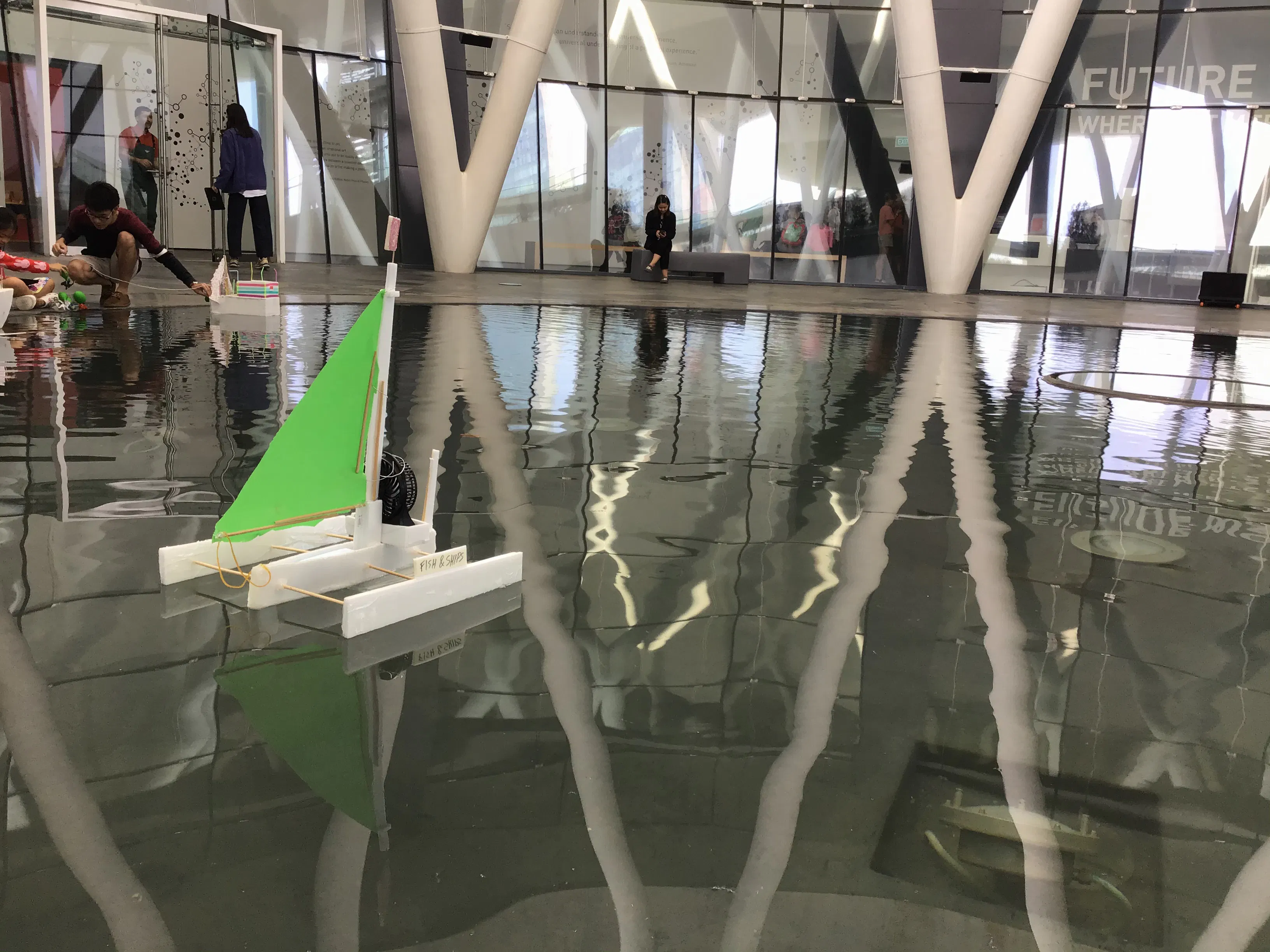
Subsequent sketches and iterations removed the masts and the outer hulls, instead replacing them with outriggers. A mount of a powered fan was added to provide additional power when wind was scarce. The addition of a fan necessitated the addition of more foam to improve buoyancy at the front of the boat. A rudder was added along with a keel to improve stability and directional control.
4. Overall dimensions, tools and materialsLength: 38cm
Width: 42cm
Height: 65cm
Materials: foam board, chopsticks, metal wire, cloth, powered fan, rubber bands
Tools: hot glue, clear tape, masking tape, rubber bands, scissors, pen knife, cordless drill
5. Building step 1 (hull and outrigger)To build the hull, 2 foam pieces were taped with clear tape and scored on the reverse side to allow for slight bending without breaking. After both ends are hot-glued together, a base was traced out on foam board, cut and hot-glued on. Drill 3 holes on each side of the hull for mounting of the outriggers.
2 pieces of foam were glued together to form each outrigger. 3 holes were drilled and chopsticks fixed in place using hot glue before mounting onto the hull with hot glue again.
Fill the hull with foam to improve buoyancy.
6. Building step 2 (mast and sail)Using more foam, cut a long and thin piece to be used as the mast. Add the mast on and stabilise with chopsticks and hot glue on each side.
For the sail, cut a piece of cloth into a right-angled triangle or any other sail shape. Poke 3 holes along the side that will be attached to the mast with wire. Use metal wire to hook around the mast.
Cut 2 rubber bands to limit the sail’s movement. At the trailing edge of the sail, hot glue the rubber bands to the stern of the hull.
7. Building step 3 (fan mount, keel, rudder and additional buoyancy)Using foam the length of the hull, hot glue the keel onto the underside of the hull. For the rudder, add another piece of foam to the bottom and stern of the boat as the rudder.
To create a mount for the fan, make a box with the dimensions of the fan and use hot glue and foam. To improve buoyancy, layer pieces of foam that are stacked up and glue onto the front of the boat, beneath the keel.
8. Testing in the waterInitially, the movement of the sail was not limited. This made the boat travel sideways instead. Thereafter with the addition of the keel and limiting the sail, the boat became more directional.
The prototype was tested without the addition of the fan first. However, the lack of wind did not allow for the prototype to sail. A decision was added to the fan to boost the speed and to counter the weight of the fan, additional buoyancy was added.
The result was a prototype that could sail with wind when the wind was strong enough, but was also able to use the fan as an additional power source.
9. Feedback I gotTo limit the movement of the sail, and addition of a keel and rudder to improve stability and directional control
To reinforce the mast to prevent the mast from breaking if the sail is too heavy
To add the fan, and offset the weight, improving buoyancy to increase speed
10. What I learnVarious hull shapes, hydrodynamics, how to use different materials, and the cultural and historical significance of boats.


Comments