

Project Aura is an open-source ESP32-S3 air quality monitor with industrial Sensirion sensors, a 4.3" IPS touchscreen, solderless assembly, and native Home Assistant integration via MQTT. If you're new here, the full project overview is in the original article. This post covers everything that changed since then.The Campaign Closed — Here's Where We Are
The MakerWorld crowdfunding campaign wrapped up with 2, 000+ backers and 385 GitHub stars. Late Pledge is still open if you want access to the enclosure STL files, PDF build guide, and web installer.
The firmware is at v1.1.1. Here's what's new.New Optional Sensor: CO (DFRobot SEN0466)The sensor stack now includes an optional direct CO measurement module. Like the other optional sensors, it's presence-detected at boot — if it's connected and working, CO becomes part of the live dashboard and Home Assistant entities. If it's not there, the system continues normally without it.
This expands the full optional sensor list to:
- SFA30 — formaldehyde (HCHO)
- SEN0466 — carbon monoxide (CO)
- DFR0971 — 0–10V DAC for ventilation control
Ventilation Control: 0–10V DAC Output
With the optional GP8403 module (DFR0971), Aura can now drive any 0–10V compatible fan, ERV, or ventilation controller automatically.
The key design decision was to not pick a single trigger metric. The firmware evaluates all enabled sensors simultaneously — CO₂, CO, PM2.5, VOC, NOx, HCHO, and more — and drives the output from whichever one is currently worst. If CO₂ is fine but VOC just spiked from cleaning products, the fan responds to that. The logic reacts to the actual problem, not an average.
Manual mode: 10 fixed voltage steps from 1V to 10V, with timers from 10 minutes to 8 hours.
Auto mode: explicitly armed by the user — you start it intentionally, and a manual stop stays stopped until a new Start is issued. After reboot, auto mode waits 15 seconds before resuming. Current output is always visible in both volts and percent, with RUNNING / STOPPED / FAULT status.
Disabled or missing sensors are simply excluded from the auto calculation — no errors, no false triggers.
Expanded Hardware CompatibilityOne of the most common questions from builders: "I can't find the exact part — will X work?"
The firmware now auto-detects a wider range of compatible chips so you can build from what's actually available.
Pressure Sensors — Now Six OptionsPreviously: BMP580, BMP581, DPS310. Now also: BMP585, BMP388, BMP390.
The firmware probes in order and identifies the installed chip by ID, including shared-address disambiguation to avoid false positives on a busy I2C bus.
RTC — DS3231 Now SupportedPreviously: PCF8523 only. Now: PCF8523 or DS3231, auto-detected at boot.
Both chips live on address 0x68, so a simple ACK isn't enough. The firmware uses a multi-step probe — checking control registers and temperature data — to correctly identify which chip is installed. Manual override is also available. The detected RTC type is shown in the UI.
Optional Modules — Graceful HandlingSFA30, SEN0466, and GP8403 are all presence-detected at boot. Each can be absent, present-and-working, or present-but-faulted. The firmware handles all three cases without affecting the rest of the system.
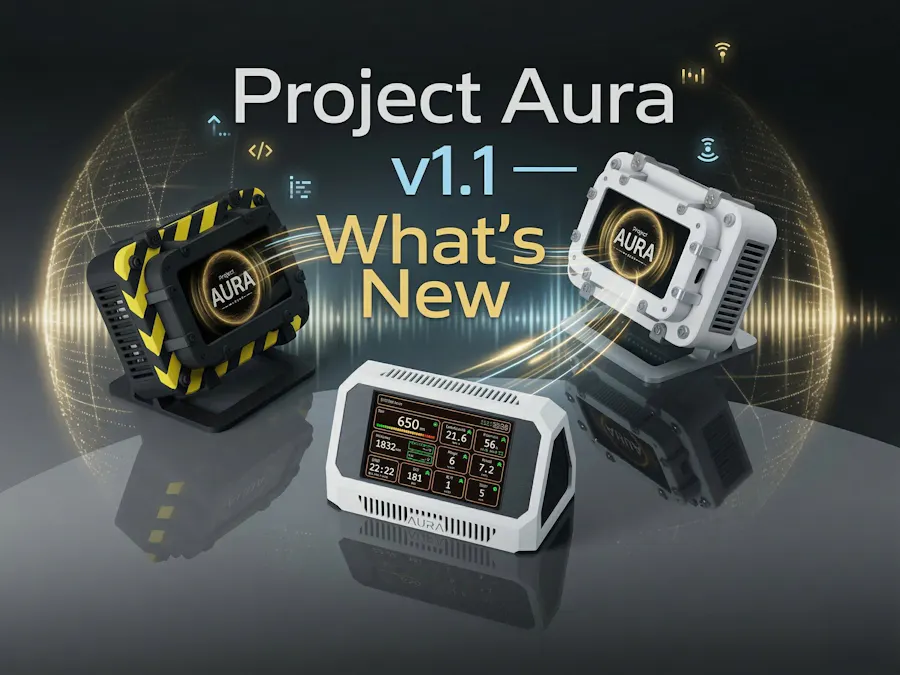
Two New EnclosuresThe original desktop case is still available. Two new STL variants are now included for backers:
Wall-mount — sits flush against the wall. Good for hallways, bedrooms, or anywhere desk space is limited.
Industrial — heavier aesthetic, works well in a workshop or utility environment.
Full Feature OverviewResources- GitHub:github.com/21cncstudio/project_aura
- MakerWorld Late Pledge:STL files + PDF build guide + web installer
- Original article (v1.0):https://www.hackster.io/


Comments