



Hardware components | ||||||
 |
| × | 1 | |||
 |
| × | 1 | |||
| × | 1 | ||||
APPLYING FOR THE FOLLOWING AWARDS:
NASA -- OUT OF THIS WORLD AWARD
BEST PROJECT AWARD
FORMECH SUSTAINABILITY AWARD
As of 5 July 2016, the United States Strategic Command tracked a total of 17, 852 artificial objects in orbit above the Earth, [3] including 1, 419 operational satellites.[4] However, these are just objects large enough to be tracked. As of July 2013, more than 170 million debris smaller than 1 cm (0.4 in), about 670, 000 debris 1–10 cm, and around 29, 000 larger debris were estimated to be in orbit.[5] Collisions with debris have become a hazard to spacecraft; they cause damage akin to sandblasting, especially to solar panels and optics like telescopes or star trackers that cannot be covered with a ballistic Whipple shield (unless it is transparent).
The Kessler syndrome, a runaway chain reactionof collisions exponentially increasing the amount of debris, has been hypothesized to ensue beyond a critical density. This could affect useful polar-orbiting bands, increases the cost of protection for spacecraft missions and could destroy live satellites.
Whether Kessler syndrome is already underway has been debated.[8][9]The measurement, mitigation, and potential removal of debris are conducted by some participants in the space industry.
Update 1: 8:40Currently still in planning stages. What is it going to look like? What ill be attached? etc.
Update 2: We have separated our goals into "what we need" and "nice to haves." A list with details and assigned roles have been made. We will circle back to this tomorrow to see how far we have progressed, and based on this information, address our "nice to haves"
Update 3: As of Saturday morning our servo is more or less functioning in 1-D, more testing is needed. The next step is to create a support structure to mount the laser pointer and LiDar device to in a straight line.
Update 4: 2D movement was added by creating a tilting base for both the Lidar and the laser pointer. These were wired to a preliminary base. At this point our servo overheated and needed to be replaced
Update 5: Once the servo was replaced, testing in 2D resumed
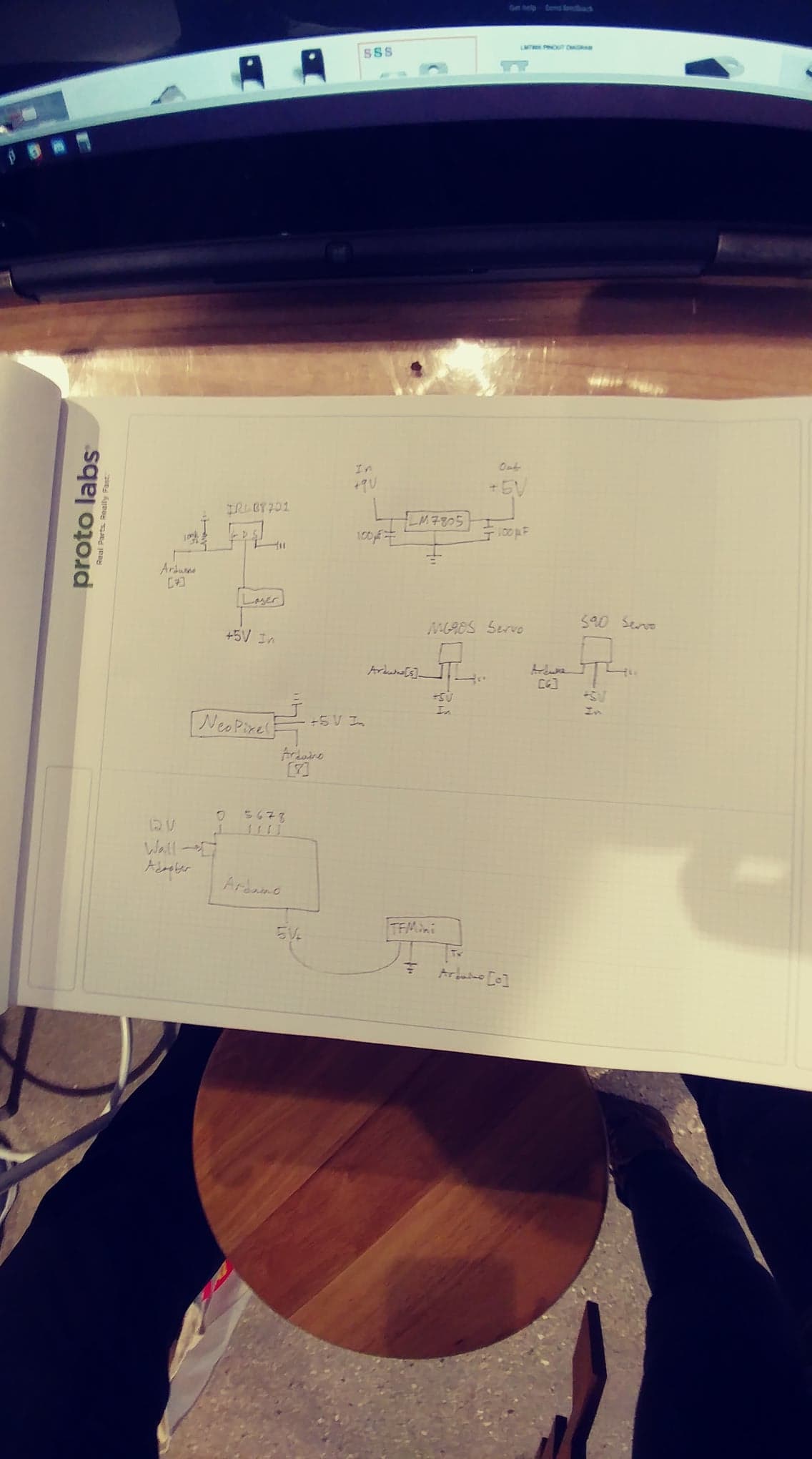
Finalelectronicsinsummary:
Power Supply- 9v battery connects to 5v regulator. Avoids drawing too much current from Arduino. Capacitors make up for voltage changes.
- Input voltage max of 35v
- 2 power supplies: One powers servos. One powers lasers. Avoids drawing too much current. Wired on a perfboard for robustness.
-Headers on the breadboard make it easy to connect and disconnect servo
MOSFET switch- Controls the beam of the laser pointer
- Decided to go with this method to prevent too much current draw from arduino
- Allows a more powerful tool to be use
- Tx of Lidar connects to Arduino pin 0 (Rx)
- Power connects directly to arduino
- Disassembled a run-of-the-mill laser pointer
- Used a multimeter to find out how it works
- Bypassed the built in pushbutton since we were controlling it with MOSFET
The Bebop’s Arduino Uno runs a simple control loop. The Arduino sweeps the lidar servo up or down by one degree, reads a record from the lidar to check for an object either entering or leaving its detection range, and records the maximum and minimum positions of any object encountered. Once both edges of an object have been recorded by the lidar, the Arduino calculates a position for the laser servo using the law of cosines, aims, and sends a signal to fire over GPIO. The Bebop’s code is available on https://github.com/westphallm1/BeBop.
ThermoformDesign
For our thermoformer project we wanted to create something useful, reusable, and appealing. Once we decided on a phone dock, we brainstormed specific features that could be added such as an ideally angled bed for phone use while on the dock, an easy way to charge the phone, and a specific geometric shape that channels sound waves to provide a clear and amplified sound from the phone. We spent a lot of time working on the geometry for sound coming from the phone. We had to create an object that simultaneously held the phone securely, channeled sound, and was easily reproducible with the thermoformer.The team juggled ideas such as an outward curved base and bowl shaped designs, but ultimately settled on a structurally secure multi-purpose design that served multiple functions instead of focusing on just one. Our final product was designed using Rhino CADsoftware and printed in an “Ultimaker 3” 3-D printer, which can finally be used to quickly replicate the same shape in a vacuum thermoformer.


Comments