


Hardware components | ||||||
 |
| × | 1 | |||
| × | 1 | ||||
| × | 1 | ||||
| × | 1 | ||||
| × | 1 | ||||
 |
| × | 2 | |||
| × | 1 | ||||
 |
| × | 1 | |||
| × | 1 | ||||
Software apps and online services | ||||||
 |
| |||||
 |
| |||||
Hand tools and fabrication machines | ||||||
 |
| |||||
 |
| |||||
Water quality in the UK is frequently in the news – sewage spills, algal blooms and debates about whether the River Seine in Paris is fit for Olympic swimming remind us that clean water isn’t guaranteed anywhere. When my kids go sailing at the Welsh Harp reservoir, the water often looks and smells bad. Sailing doesn’t require full immersion like swimming, but falls happen, and there’s no way to tell whether the water is safe (that is also the most fun part if you ask me!).
So a real‑time indicator would reassure us when conditions are good and help us push for improvement when they’re not.
That’s where the Smart River Guardian comes in: a simple, modular, edge-AI powered device that reads water quality and gives a quick **RAG (Red–Amber–Green)** signal. It’s not perfect yet, but it’s already splashing with potential!
The Journey1. Planning (keep it simple)I started with the essentials:
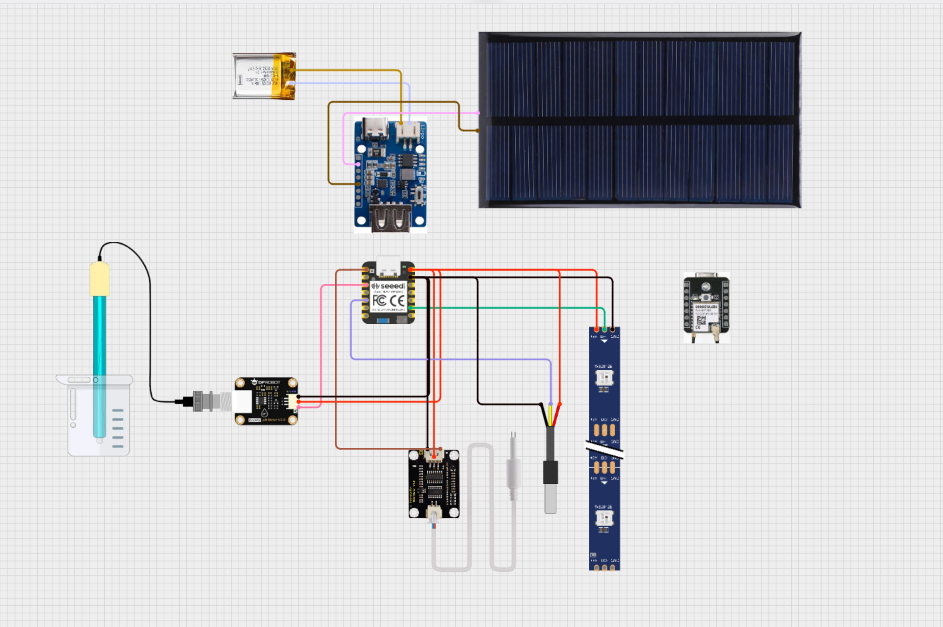
- Sensors → pH, TDS, temperature
- Feedback → a NeoPixel ring to give instant *safe / careful / avoid* visual status
- Brains → Seeed XIAO nRF52840 (good for TinyML, low-power, onboard charging)
- Aspirations → SX1262 LoRa, solar charging with LiPo Rider Pro + MPPT, custom PCB (thanks NextPCB), and even the new XIAO nRF54L15 with Zephyr for future exploration
I went one component at a time, testing, debugging, and making sure each worked before adding the next.
- First the temperature sensor, then TDS, then pH
- NeoPixel added for simple visual and instant feedback
- Arduino code incrementally updated (see GitHub repo)
Once the setup worked, I exported data streams into Edge Impulse.
- Trained with three liquids: tap water, mineral water, Coca-Cola
- No real river water yet → so this is just proof-of-concept
- Calibrations were rough, but enough to classify
Edge Impulse project is available at https://studio.edgeimpulse.com/studio/789893
4. Training & Inference- Trained a quick model (yes, the video is wobbly!)
- Deployed back to the XIAO → real-time predictions on the edge
- NeoPixel shows Green = Safe, Amber = Careful, Red = Avoid
5. What’s Next- A tidier 3D-printed case (instead of jumper-wire-spaghetti!)
- Collect real river data → refine the model
- PCB design with NextPCB → plug-and-play, solar-ready version
- Add LoRa for remote river health monitoring
- Future exploration with nRF54L15 + Zephyr + TinyML
ConclusionThe Smart River Guardian is a playful but serious attempt at showing how Edge AI + simple sensors can make our rivers more transparent (literally!). Today it classifies “tap vs Coke,” tomorrow it might keep swimmers, rowers, and fishers safe.
Thanks to NextPCB for extending their support — the journey from messy breadboard to sleek PCB has only just begun
Useful links:- https://wiki.seeedstudio.com/XIAO_BLE/#software-setup
- https://wiki.seeedstudio.com/XIAO_BLE/#q3-what-are-the-considerations-when-using-xiao-nrf52840-sense-for-battery-charging
- https://wiki.seeedstudio.com/XIAO_BLE/#seeed-studio-xiao-nrf52840-sense
- https://how2electronics.com/tds-sensor-arduino-interfacing-water-quality-monitoring/
- https://docs.edgeimpulse.com/tools/clis/edge-impulse-cli/data-forwarder and this for the protocol
- to create the sample data for the edge model https://github.com/edgeimpulse/tool-data-collection-csv

Comments