


Hardware components | ||||||
| × | 1 | ||||
_ztBMuBhMHo.jpg?auto=compress%2Cformat&w=48&h=48&fit=fill&bg=ffffff) |
| × | 1 | |||
| × | 1 | ||||
| × | 1 | ||||
| × | 1 | ||||
| × | 1 | ||||
| × | 1 | ||||
Software apps and online services | ||||||
 |
| |||||
| ||||||
Hand tools and fabrication machines | ||||||
 |
| |||||
| ||||||
Into the Void is an interactive sensory installation that explores the emotional relationship between discomfort, curiosity, and self-created comfort through touch, sound, and movement. The project began with a simple but important question: what if comfort is not something that should immediately be given to us? What if, instead, we are capable of finding and creating comfort for ourselves by first accepting discomfort and moving through it?
Rather than designing an experience that instantly feels safe or calming, we intentionally wanted participants to encounter unfamiliar and unsettling sensations at the beginning of the interaction. The project encourages people to become active participants in their own emotional transition instead of passively receiving comfort from the environment. The discomfort is not something to avoid; it becomes the starting point of awareness, adaptation, and transformation.
The installation was designed as a space where participants could physically interact with textures, sound, and darkness while gradually discovering a sense of grounding and emotional calmness through their own movement and exploration.
Concept DevelopmentThe conceptual narrative of the project was built around the experience of entering an unknown sensory void:
“You stand at the edge of a lightless void, a dark circle that swallows your vision. As you step forward, you don’t descend with your eyes, but through your feet. The initial plunge is triggering; the floor is a mystery of textures that shouldn’t exist together. Is it the slime of mud, the grit of sand, or the chilling movement of worms? This intimacy with something you’re not familiar with creates an immediate flash of irritation and anxiety.
As you sink deeper, the darkness forces a raw awareness of emotions. The tactile resistance beneath your soles feels like a sense of pain, a physical manifestation of remembering emotional difficulties. But then, you begin to move. You stomp, glide, and draw through the unseen medium.
Suddenly, the void speaks back. You are collaborative now, your movements sensing the floor to produce a rhythmic, haunting audio output. This sonic emotional expression begins to evoke curiosity, shifting your internal state. The “not knowing” is no longer a threat; it is a fascinator.
The vibration of the sound and the cool embrace of the material helps you transition. What began as a jarring sensory overload matures into a profound grounding and calming sensation. You are no longer lost in the dark; you are anchored by it. In this space, you find a strange, quiet peace—a transformation from the friction of the unknown into a deep, resonant stillness.”
This narrative became the emotional foundation of the installation. The project was never about removing discomfort entirely; instead, it explored the possibility that discomfort itself can become a pathway toward comfort if we allow ourselves to engage with it rather than escape it. We wanted participants to experience the process of emotionally adapting to unfamiliar sensations and discovering calmness through their own interaction and presence.
The idea was rooted in the belief that meaningful comfort is often not something externally provided in a ready-made form but something we actively create for ourselves by confronting uncertainty, vulnerability, and sensory tension.
To translate this concept into a physical experience, we designed four separate sensory stations, each containing materials with different tactile qualities and emotional associations. The stations included sand, stone, and biomaterials made from algae, mud, and grass-like organic textures. Each material was carefully selected to create contrasting sensations and provoke different emotional reactions.
The sand created instability and friction, while the stone surfaces felt cold, rigid, and resistant. The biomaterial station introduced wet and organic textures that felt unfamiliar and slightly uncomfortable, encouraging participants to become more conscious of their bodily reactions. Together, these materials created an environment where touch became the primary language of interaction.
Participants could not fully predict what they were touching or stepping on, which amplified the sense of uncertainty and emotional awareness throughout the experience.
The installation combined physical computing with real-time audiovisual systems. Each sensory station contained capacitive sensors connected to the tactile materials inside the boxes. Whenever participants touched or stepped onto these surfaces, the sensors detected the interaction and translated physical movement into digital input data.
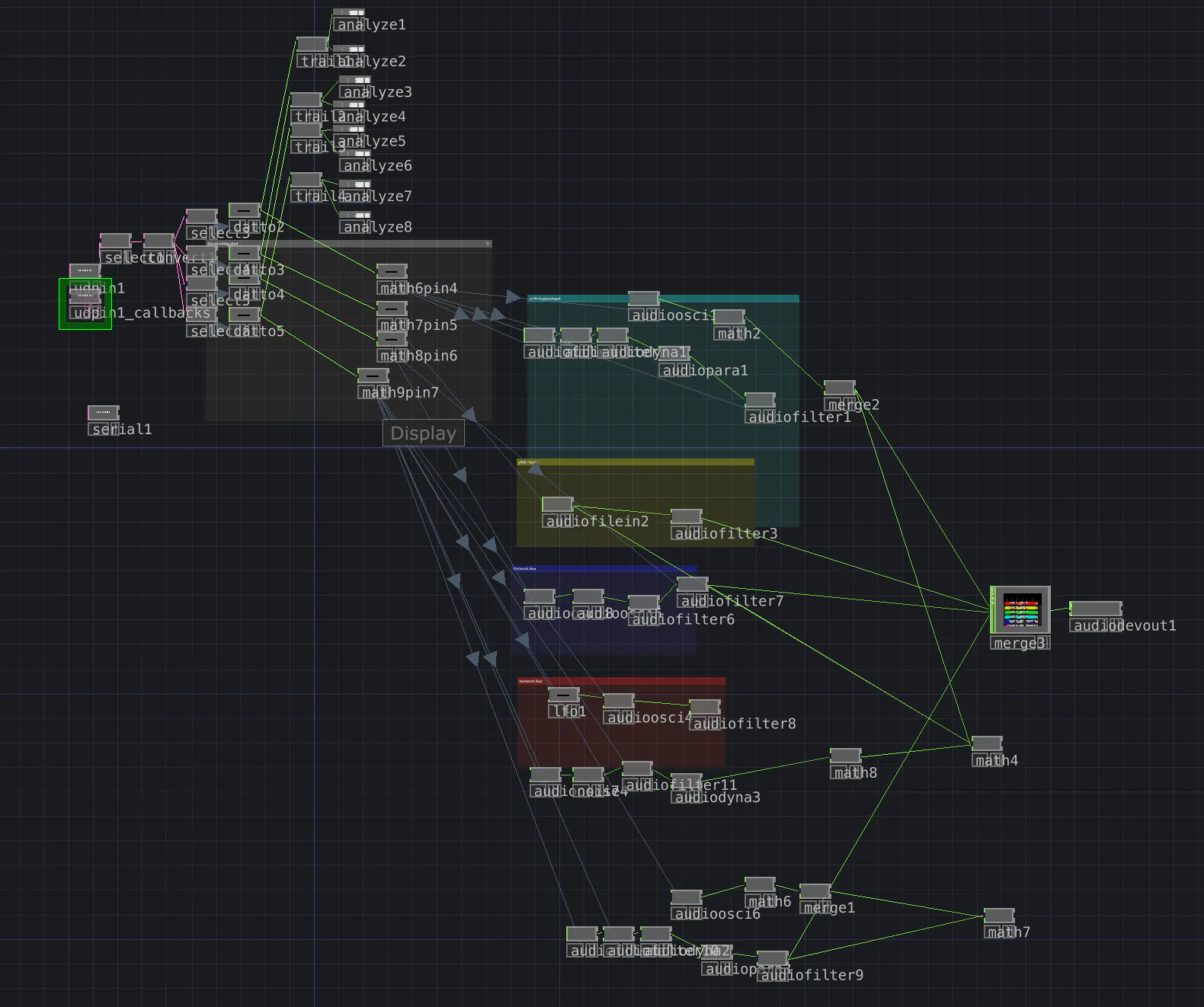
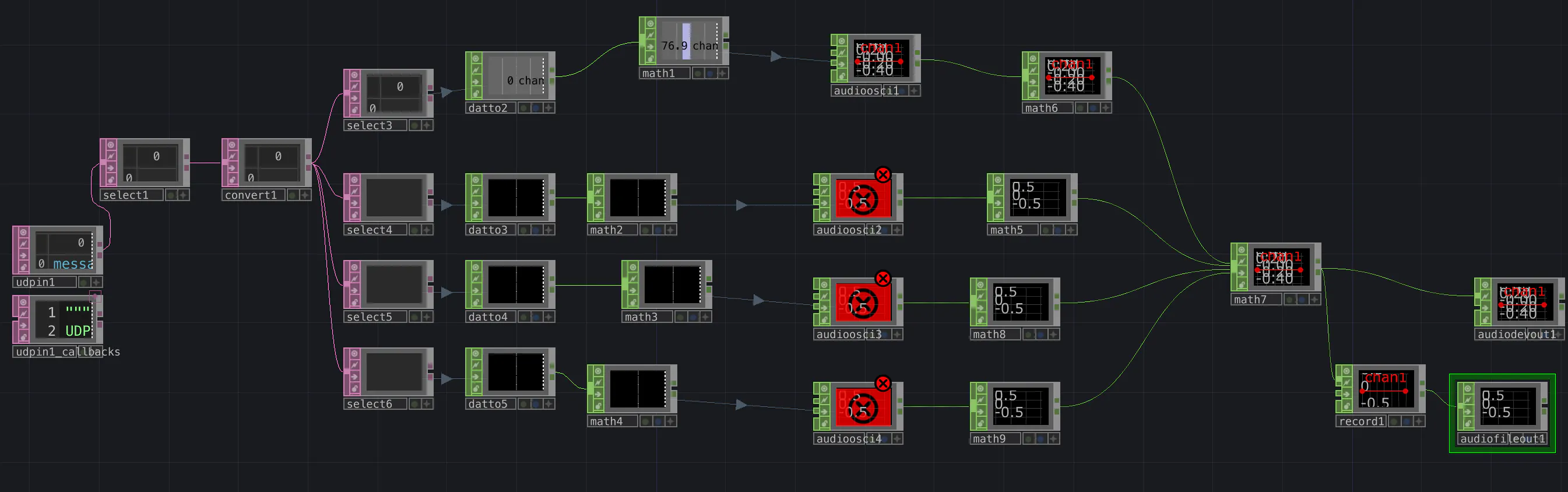
We used Arduino to process sensor information and send the data into TouchDesigner, where the audiovisual environment was generated in real time. The sounds and visuals were designed to evolve dynamically based on interaction, allowing participants to influence the emotional atmosphere of the installation through their own movement.
The first learning was that there is no need to map data in the code if you are using TouchDesigner for the output, because you can do it easily using Math CHOPs. You can see the readings directly and based on those values determine the range of each material's untouched state. The first code Claude gave me included mapping, and the values I was reading were in the millions, when readings are that high, the circuit needs a ground, which we didn't know at first. It was hard to figure out, but thanks to Mikel we understood why the sensor wasn't reading when touched alone, but would start reading when you touched the computer with one hand and the sensor with the other. When the values are lower, which should be the case from the start, the sensors work perfectly. So a grounding problem can directly affect the quality of the readings.
The second learning was around communication between boards. We initially tried to implement the ESP-NOW protocol with two boards so that the computer wouldn't need to be physically connected to the artifact. Aurel then introduced us to a simpler way: through UDP over WiFi , where data is sent directly to TouchDesigner using a single board. To set it up you just add the WiFi credentials and the computer's IP address into the code, and in TouchDesigner you use a "UDP DAT" instead of a "Serial DAT." One thing to remember: if you move to a different location or switch to a hotspot, you need to update the IP address.
The third learning came during the presentation, where the artifact wasn't working correctly. The data was transferring fine and mapping correctly, but the sound output was only working for two sensors, touching more than one at the same time would either go silent or one sound would overpower the others. After digging into it I found a couple of reasons for this. First, in the Math CHOP the properties "Combine Channels" and "Combine CHOPs" behave differently. Combine Channels works within a single input and merges the channels inside it, while Combine CHOPs takes multiple separate inputs and combines them together, which was what I actually needed. Second, and more importantly, was a volume issue. The Math CHOP multiplies every input introduced to it, so when more than one input is active they can together exceed the 0–1 range, causing the output to go silent. The solution was to add an individual Math CHOP before each sensor's signal reaches the final combining CHOP, and in each of those set the Multiply parameter from 1 to 0.25. That way, even when all four sensors are touched at once, the final Math CHOP receives a combined value of exactly 1 and outputs clean audio.as creating smooth communication between Arduino and TouchDesigner without interruptions or latency issues. Because the installation depended heavily on real-time responsiveness, even small delays could break the immersive quality of the experience. After extensive testing, debugging, and calibration, we were able to stabilize the system and create a fluid interaction between touch, sound, and visuals.
The physical installation was developed through a combination of digital fabrication and manual construction techniques. We used laser cutting, woodworking, carpentry, and 3D printing to fabricate the boxes, structures, and interactive components of the project.
A significant part of the process involved experimenting with materials and testing how different textures interacted with both the sensors and the participants themselves. We wanted the technological elements to remain subtle so that participants would focus primarily on the sensory and emotional experience rather than the hardware behind it.
The final result became a hybrid environment that combines tactile exploration, physical computing, sound design, and interactive media into a single immersive experience.
Into the Void became a personal exploration of how people emotionally respond to discomfort and uncertainty. Instead of creating an experience that immediately feels comforting, I wanted participants to discover comfort through interacting with discomfort itself.
This idea became deeply connected to gratitude for me. People often focus on unpleasant details even in beautiful moments, like wet clothes in the rain, spilled coffee, or stepping into mud, while overlooking the quieter beauty around them, such as silence, nature, or the sound of birds in the background. I wanted the installation to recreate that emotional shift.
The biomaterial station reflects this idea clearly. The slimy algae-based texture initially feels uncomfortable and unfamiliar, but after interacting with it and hearing the calming natural sounds that follow, the experience gradually transforms into something more peaceful and grounding.
For me, the project is ultimately about accepting discomfort instead of resisting it, and understanding that comfort is sometimes something we create ourselves through awareness, interaction, and perspective.


Comments